Posts by Maria Greene

Why Are UU Humanists Overlooked?

Over breakfast this morning, my husband told me about an interesting NY Times article that I should read, "It mentions your UU Humanist organization," he added. I was skeptical, but I thought perhaps I had missed something since I had been busy all day yesterday at a memorial for a cousin and hadn't even glanced at social media. After a quick scan of my Facebook news feed, I concluded he meant this article, "Wanted: A Theology of Atheism", by Molly Worthen. After reading it, I could see why he thought that it had something to do with UU Humanism. Worthen writes, "Humanist fellowships have often imitated the practices of traditional worship. Sunday Assembly’s close relative, the Society for Ethical Culture, has featured rousing music and a lecture at Sunday meetings since 1876." When one encounters the phrase "Humanist fellowships", free association usually causes the phrase "Unitarian Universalism" to come to mind to the initiated.

And of course it does. There are over 1,000 well-established UU congregations to the Ethical Culture's 22 and Sunday Assembly's brand new 100-ish (if you include the ones listed as "warm-up" as well as "established")*. A good percentage of UUs are Humanists. How many you ask? We don't know for sure. It was 46% back in 1998, the last time the Unitarian Universalist Association actually asked. It is probably lower now but it is still quite high. Why is UU Humanism not even mentioned in an article about atheists building communities that are like religious communities? We make up the largest number of this group but we are often invisible to the press and to the public.

The first, obvious answer is that we are neither fish nor fowl. Because we are not 100% non-theistic, we are not even considered in the category of "atheist churches" that the media is so enamored with. This is even though the numbers of the openly secular in our churches / fellowships / societies / congregations dwarfs those of the other organizations and even though a significant percentage of our "clergy" identify as atheist, agnostic, and/or humanist. Some people see our inclusiveness as a bug and other people see it as a feature. Personally, I think our shared (humanist) values are more important than our lack of shared beliefs, and I value our UU resources and our long history of social action that increases our ability to change the world.

The second, obvious answer is because we don't tell people. How are they supposed to know outside of our circles? "We", the UU Humanist Association, obviously tell people that UU congregations are good "Habitats for Humanism", but "we" Unitarian Universalists individuals, congregations, and the Association that represents us don't often tell people. We keep our lamp under a bushel basket, to misappropriate an analogy.

  • Our architecture doesn't tell people we are not like other religious organizations, at least not in my neck of the New England woods. Almost all of the buildings look like typical Protestant churches.
  • Our congregations' names don't tell people; about half of the UUA congregations have the word "Church" in their name. Around here, another half have "First Parish" as well.
  • Our congregations' websites don't always tell people. Many of them mention we have no fixed creed and they link to the UUA's Principles and Sources, but they omit the positive statement that atheists and agnostics are welcome here. I know, I have done the Google search "atheist site:http://www.somechurch.org" on dozens of UU congregations' websites.
  • Our ministers don't always tell people. I tell the story that my husband and I were married by a UU minister as a compromise to please my religious family; one of my siblings told me, "Find a Unitarian. They'll marry anybody." What I didn't know at the time, and the minister, who performed a wonderful, personalized ceremony, didn't mention, was that my atheist husband and I would be welcome in his congregation. Mostly likely he assumed we would just know this.
  • Our national Association does tell people on the national website if you click around the Beliefs & Principles section. And to their credit, they have reached out for feedback and are willing to make changes to make their outreach more visible and inclusive.

So, there is little pull for atheists into UU congregations except for the tired but true joke, "What do you call an atheist with kids? A Unitarian." (Guess how I finally got connected with my local First Parish Church?) Once those kids are too old for Religious Education though, few stick around.

The idea of church for atheists has really caught the media's attention. The trend in our society is toward secularism so this interest and the need for secular community will only grow, just look at the rate that new Sunday Assemblies are starting up. Just as being a Welcoming Congregation for LGBTQ people does not mean a UU congregation is unwelcoming to straight people, being welcoming to atheists, agnostics, humanists and other non-theists (who share a similar problem with the LGBTQ movement of choosing an identity label) does not mean a UU congregation is hostile to theists. We need to tell people loud and clear, "Many of us are atheists and the rest stand on the side of love with atheists, in spite of our society's misconceptions about them." We can do this as individuals (ministers or lay people), we can do this as congregations, and we can do this as the UUA.

* After re-reading what I wrote about UUA, AEU and SA numbers, I do not want to leave the impression that this is a competition. One of the best scenarios I know of is having a Sunday Assembly meet in a UU space after the "traditional" UU service to give some non-theists an experience that feels more authentic. Or an equally good scenario is to have a UU congregation that is dual-affiliated with the UUA and AEU, like the Washington Ethical Society, thereby getting the best of both of those worlds. And there may even be other good choices in a particular area, like a local Oasis or Humanist Hub. What works best depends on the community of people involved, and cooperation and collaboration will benefit all by making more styles of community available so no one group has to be "one size fits all".

Image credit: "Sky and Water I" by M.C. Escher Read more about Why Are UU Humanists Overlooked? »

Categories: 

Apply Now to The Humanist Institute

What is The Humanist Institute and why should you consider applyinging to join the new class, starting in August? As they say on the website, "Find out what you don’t know about Humanism". Here is more detail:

The Humanist Institute offers a Certificate in Humanist Studies. Students are enrolled in a small class (a maximum of 15 people) convening for eight sessions over two and half years. Classes meet in March, August and November. Prior to and in-between sessions, students prepare for class sessions through independent distance study and online discussion guided by the Assistant Dean and faculty.

Year One

The Humanist Institute does allow individuals to take just one year of it’s graduate-level program. This option allows students to gain an understanding of the Humanist life stance, values, and principles as well as Humanism in relation to others.

As our movement grows, we need more people with the skills needed to advocate for Humanism and become community leaders. Now may be the time for you to take on the challenge. Read more about Apply Now to The Humanist Institute »

Categories: 

The Thinking Atheist's Perspective on Unitarian Universalism

It's always interesting to hear an outside perspective on Unitarian Universalism. Seth Andrews, host of The Thinking Atheist podcast, did a podcast called The Unitarians, on March 3. (You can pick it up at 7:15 if you're only interested in the actual topic.)

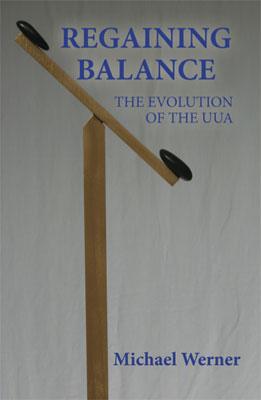
Seth interviewed UUHA board member David Breeden, minister at First Unitarian Society of Minneapolis, as well as Mike Werner, author of "Regaining Balance: The Evolution of the UUA", a book published by the UU Humanists, and others.

Please give it a listen. What did you think? Was it a fair overview of UU? And specifically, what did you think of Seth's conclusion? Read more about The Thinking Atheist's Perspective on Unitarian Universalism »

Categories: 

Ribbons Not Walls Reaches Fifty!

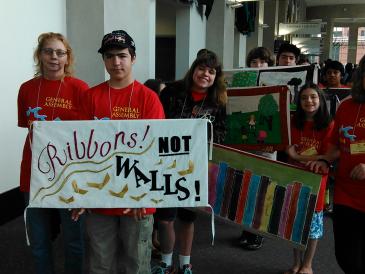
They’ve been hung from the rafters of a 19th Century barn hosting a progressive dinner dance in rural Michigan, paraded by youth for the plenary delegates at General Assembly in Providence, held by parishioners as a “living ribbon” at the close of several UU Sunday services around the country, and have welcomed customers from the walls of a neighborhood Starbucks as part of a local art walk on the south side of Chicago.   As this is written, the twenty six fabric art panels that comprise Ribbons Not Walls, a UU Humanist sponsored project on immigrant rights and culture, grace the walls at the UU Congregation of Las Vegas, for a month long program titled “Borders and Boundaries.”  It is the 50th venue for “Ribbons” since the spring of 2012, and will raise the number of viewers who have directly interacted with the art to over 8,000.

“Ribbons” began as a half dozen yard-wide panels, mostly reflecting themes and cover art from books by Hispanic authors, (see separate article on the “Banned Books” project) taken from Tucson classrooms when the State of Arizona banned “Ethnic Studies” courses.  Then the youth of the Navigator (coed, inclusive) Scouting group from Countryside UU Church in Palatine, IL contributed four batik style panels, reflecting aspects of the immigrant experience.  More contributions from a total of forty artists, working individually and in groups, were added, including depictions of humanist and UU immigration justice projects.

Of particular note are panels by the youngest and the oldest contributors – “The Wall” a rich dark acrylic on muslin rendering by 14 year old Alayana Vesto, and “Banned Books,” human figures bannered with book titles against a traditional quilt pattern, by 94 year old Gloria Weberg.  

Two panels by Linda Lee, lead artist for the Lake Apopka Farmworkers Memorial Quilt titled “Scenes from the Muck – labor and leisure” done in traditional primitive piece quilting style, toured as part of our exhibition for a year.  They have now been returned to Linda with our profound thanks - photographs of her pieces remain in the exhibition catalog.  The full farmworker quilt is known for its 128 + depictions of farmworker life, and for appearances throughout southern states at union rallies and social justice gatherings.  

The latest additions to the collection are two Commemorative panels for victims of the Los Gatos plane crash, subject of the Woodie Guthrie song “Deportee.”  For decades, activists have worked to uncover the names of the twenty eight braceros who died following their legal work on the California harvest.  Just last year the last identities were uncovered, and a new engraved headstone bearing all twenty eight names, marks the place where they were buried anonymously.  Much of the work was done by author and performance artist Tim Hernandez.  UU Humanists is proud to partner with Tim and others who worked on the 28 Deportees Memorial, by gathering small fabric panels of handprints (a sign of support) and leaves (from Guthrie’s line “Who are these Friends, all scattered like dry leaves?”) made by UU and Humanists children and adults around the country.   These are being stitched into panels, each one bearing one of the names. 

Ribbons Not Walls is an artistic response to a highly complex political issue.  In the finest humanist tradition, we use the emotional and intellectual impact of the artist’s vision, to ask audiences to engage the culture and the struggles of immigrant communities and individuals.  We do not ask you to take a particular stand (though several of the individual artists clearly do), but simply to be open to letting the works speak to you.  

The growing “Ribbons” collection will go from Nevada to Florida for at least two winter appearances, and then back north in March to be displayed at the Ohio Meadville/St. Lawrence District Meeting in Niagara Falls, NY, and then at the MidAmerica Regional Meeting in Naperville, IL.  You can also see the collection at the UU Humanists booth at the UUA General Assembly in Portland, next June.

If none of these venues are on your itinerary, perhaps you’d like to bring the Ribbons exhibit to your congregation or Humanist group.   Contact curator Roger Brewin at Rabrewin@aol.com or call him at 773 881 4028, or cell 773 551 8540 to make arrangements. Read more about Ribbons Not Walls Reaches Fifty! »

Categories: 

John's Excellent Adventure

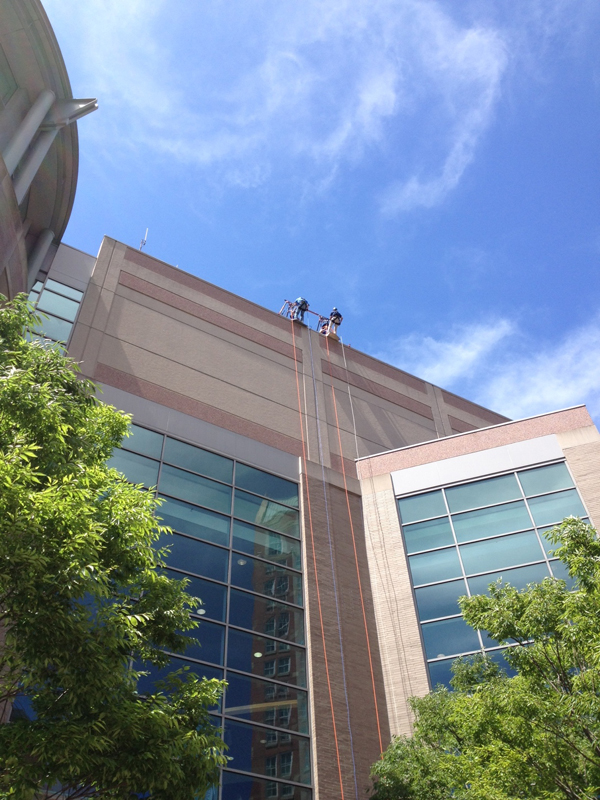
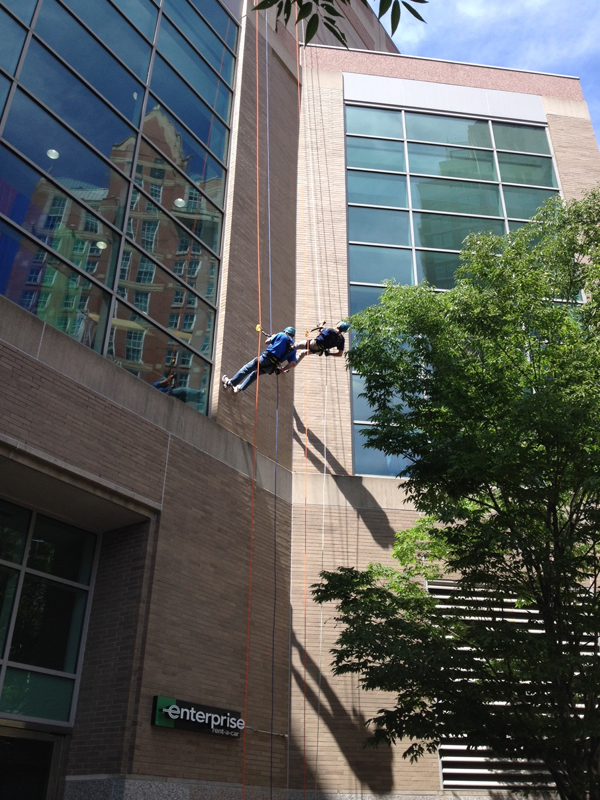
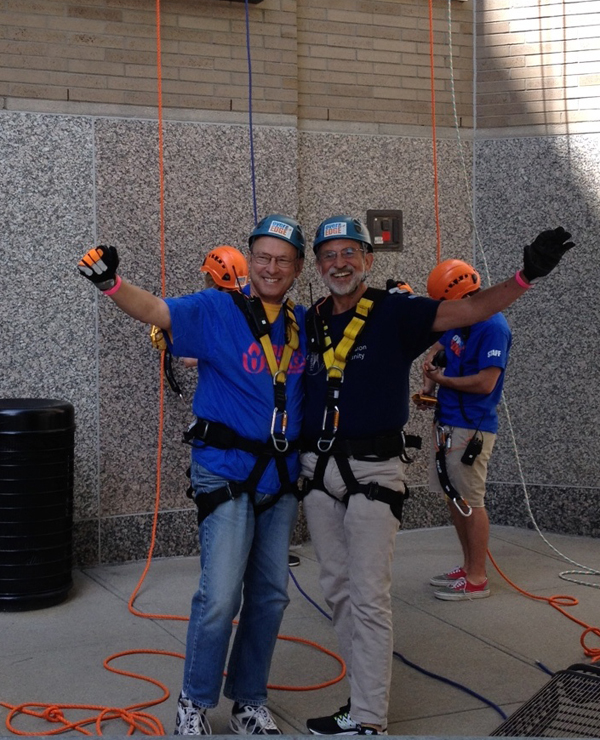
At GA in Providence this last June, some brave souls, including UUHA president John Hooper, were invited to Pledge Over the Edge in support of the Rev. Terry Sweetser Fund for Stewardship of the UUA. Here are some pictures of John and his friend from the UUA President's Council, Les Polgar, from California, rappeling down the side of the Providence Convention Center. 

Stepping Off

John Rapelling Start

Half Way

John Rapelling Half Way

They Made It!

John Rapelling End

It's hard to see through the harness, but John (on the right) is modeling his UU Humanist t-shirt. Great job, Les and John! Read more about John's Excellent Adventure »

Categories: 

Humanism and Unitarianism: Final Class Words

[Editor's note: Mike Werner, author of Regaining Balance: The Evolution of the UUA, recently taught a class for SecularActivism.org called "Humanism and Unitarianism". Here are his "final words" to the class as it wrapped up. What are your thoughts?]

What can we learn from the Unitarian Universalist experience that can be applied to building humanist communities of the future?

1) Once you lose your focus; your market brand it is hard to regain it. Trying to be all things to all people does not work. People want their religion narrowly focused and meaningful. Every study puts being with like mind people as the main reason to be in our movement, not to be with people vastly different than them. If Humanist groups defocus their energies in supporting the merely humanistic, rather than the naturalistic humanists, the humanism within it is lost eventually.

2) Postmodernism’s poisonous ideology of radical relativism undermines all of progressive liberalism. We may not have certainty, but science provides us tools to explain, make prediction and control the world. Science is true because it works despite the fact that is gives us knowledge that is fallible, tentative, and probabilistic.

3) Always keep a balance of our highest values and don’t let any of them become secular god. Tolerance, reason, justice, love, compassion are all great values, but never have any of them overwhelm all the others.

4) There is no single model of a humanist community that will work. We need multiple models and even within our communities we more than ever need a “cafeteria” of alternatives. Many of the most successful atheist communities are merely social gatherings, or “Drinking skeptically” as some are known. Most of the atheist youth are not involved with organized groups and seek the blogosphere and social media for their community. How do we capture that?

5) Professional leadership may actually harm a group’s growth. You can tell the inflection point in a religious denominations growth curve when professional leadership comes on board. We don’t understand all the reason for this, but the religious ministerial model may not work in the future. What may work is professional leadership that acts more as a coordinator, educator and manager than a minister.

6) The UUA does community real well and humanism very poorly. It used to do both well. The humanist communities, by and large, do humanism very well and really fall short on skills to build intentional communities. How do we do both?

7) Many young people enter the UUA when their children start asking questions. Parents want a liberal community for their children that nurtures, educates and lets the children know they are not alone in their beliefs. The UUA cannot hold onto children because they don’t provide an evocative grounding. Hodding Carter is famously quoted saying, “There are only two lasting bequests we can hope to give our children. One of these is roots, the other, wings.” We do great on the wings, but the children are left to fly direction-less which is possibly why the UUA has the lowest retention ratio of any denomination at only 12%.

8) Be careful with words. Words have the power to create meanings or destroy them. I think it is more than time to withdraw from the religious redefinition game. Even John Dewey saw his use of religious language as metaphor as an evolutionary technique not a revolutionary one. While many may think the language of reverence is inclusive, that it is not for the vast majority of humanists.  Millenials, in particular, have a great distaste for the religious redefinition game.  It decidedly favors the theistic point of view.

9) Lastly, Humanism is a blend of both the Enlightenment and the Romantic projects and a full humanism embraces both the heart and the mind, reason and compassion.

I originally asked you why you are here. I think you and I are here because we want a better world. We want a better world, but we believe that secular values, indeed Humanist values will make a better world. This isn’t just about the “right-ness of our cause, but the practical effects. There is something more though.

Our hearts long for an integrated whole view of life that matches with reality. We long for a vital center to our lives that both grounds us and inspires us, a vision of grander authenticity to our lives and not just smaller truths. All of us long for an evocative whole story and higher vision that lifts our hearts, moves our society, pushes us to higher meanings, and ennobles our lives. Some may find that integrated story is already there in the balanced humanist secular life of here and now, of heart and mind, reason and compassion, accepting the exhilarating challenge of moving toward a responsible search for truth and meaning.

The humanist lifestance is based on our values, not our beliefs, where open-minded critical thinking, science, justice, freedom, tolerance, democracy, compassion, human rights, inherent worth and dignity, and human flourishing hold our web of belief together.

We can’t afford the luxury of just critiquing religion. We must tell our alternate story so that those contemplating change know there is an alternate worldview that can support, inspire, and comfort them; that the knowledge of science, while tentative, is surely firmer than blind faith; that the exhilaration of focusing on the here and now is more meaningful than otherworldliness; that hope and love are certainly better than hate and divisiveness; that compassion and responsibility can be balanced with self-interest and freedom. That ambiguity that is inherent in all our value/ethical/political choices we spoke of earlier need not paralyze us, but it does make it even more important we reflectively consider all our choices.

Humanist ethics derives its power by affirming the inherent worth and dignity of all people and realizes that if justice is to be given only we can give it. If love is to be given only we have the power in this moment and in this hour. By not doing so, the opportunity is lost forever. Suffering not relieved is real suffering, not washed away by the hand of a loving god when we die. This world is all and enough. Enough to fill us with joy and wonder and hope and awe that is our natural birth right.

Now is our time and now is our chance to move society toward reason and the good life. Now is our time to move society out of the dark ages of theocratic and ideological control toward human fulfillment. We cannot falter in the face of certain hostility, our own inherent ambiguity, and we cannot stand idly by hoping for a secular society to automatically shape itself. It is our duty to show that a secular world need not end in nihilism, but we can build communities that embrace a progressive, humanist, ethical worldview of human and global good. Read more about Humanism and Unitarianism: Final Class Words »

Categories: 

GA Program: Reaching Out to the Nonreligious

Listen to the Audio: 

How can UU congregations and ministers make their non-theist members feel welcome and included? The UU Humanist Association sponsored a panel discussion at the 2014 UUA General Assembly in Providence, RI to consider a number of different ways.

We discussed three main approaches to providing a comfortable environment:

  1. Dedicate the entire congegation to Humanism. This is the approach taken by Rev. David Breeden's First Unitarian Society in Minneapolis, MN, the "flagship" Humanist congregation in the UUA. This can work well, especially in an area where there are several UU congregations where one can "specialize" in Humanism.
  2. Have a regular Humanist service. This is how Senior Minister Marlin Lavanhar's congregation, All Souls Unitarian Church in Tulsa, OK, dealt with a merger that resulted in a very theologically-diverse membership.
  3. Build a strong Humanist local group for mutual support. Chris Stedman, author of the book "Faithiest" and now of the Yale Humanist Community, and Sonia David, an intern at the Humanist Community at Harvard, are working to develop this model.

You can watch the entire presentation here (audio quality is not great) or listen to it below.

A special thank you to our friend Steve Ahlquist from the Humanists of Rhode Island for the video and pictures! Read more about GA Program: Reaching Out to the Nonreligious »

Categories: 

Pages