Posts by Daniel Braga-Lawlor

Fight Theocracy: Share the Plate
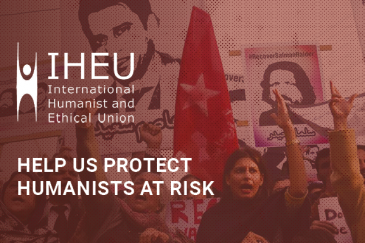
Across the world, there are individuals who are in prison for so-called blasphemy, who face murder for their skepticism, and who have been threatened with assassination for questioning religious and political leaders.

In 2014, a popular blogger in the Maldives, Yameen Rasheed wrote, "For all my tax money that goes to pay their salaries, the only service I can get in return from Maldives Police is baton charges, random threats, harassment, and rude anonymous comments on my blog – and being prevented from voting in elections."

Yameen was murdered this past April.

Humanists in wealthy, democratic countries have an opportunity to do something to help our peers around the world who are facing death threats for open expression and liberal values.

Every week, hundreds of Unitarian Universalist congregations donate to wonderful causes through Share the Plate, a tradition of sharing funds from the weekly collection with charities and community causes. All secular communities- from Humanistic Judaism to Sunday Assembly- have the possibility to take up special collections to defend the human rights of secularists overseas.

Imagine if one month out of the year, all secular and humanist groups in the US raised funds to support individuals facing violence overseas for their beliefs. The impact could be substantive.

Here are two secular human rights causes to consider gathering a special collection for. Your investments truly matter.

1. International Humanist and Ethical Union - The IHEU is a representative body of secular member organizations, including the UU Humanist Association, that advocates for universal human rights and the rights of the non-religious. Through the annual publication of the Freedom of Thought Report, the IHEU, "provides a detailed overview of areas where the law, policy and practice of states discriminates against the non-religious." The report is a what's what of justice and injustices faced by humanists in the legal systems around the world. Alongside advocating for policy change, the IHEU directly provides logistic and support services for individuals seeking asylum for their humanist beliefs. Your gifts support their work. 

2. Secular Rescue - A project of the Center For Inquiry, Secular Rescue is an organized effort to provide emergency assistance "to writers, bloggers, publishers, and activists who face threats due to their beliefs or expressions regarding religion." The group has spent over $100,000 in the past four years, supporting dozens of individuals move to safety. Shammi Haque, a Bangladeshi writer, faced death threats for her work. She told CFI, "I want only one identity: ‘Human being.’ All of my activism and my writing is for my first identity.” With help from Secular Rescue, Shammi was able to find refuge in Germany.  Any person or group can donate to CFI through their website and designate the gift specifically for Secular Rescue, or reach out to the Vice President for Philanthropy, Martina Fern, to discuss ways to support the program.

Democracy and freedom of conscience are beautiful, powerful, hopeful values that we share as humanists. We can use special collections in our fellowships, clubs and congregations to advocate for and support our peers around the world who champion democracy and secularism- and currently face imprisonment or death for it. Contact or get involved in your local community's leadership today- it's never too early to start a collection! The rotten systems in this world will get better- if we get our communities involved to change them and support our neighbors. Read more about Fight Theocracy: Share the Plate »
Categories: 

Keep the Resilience

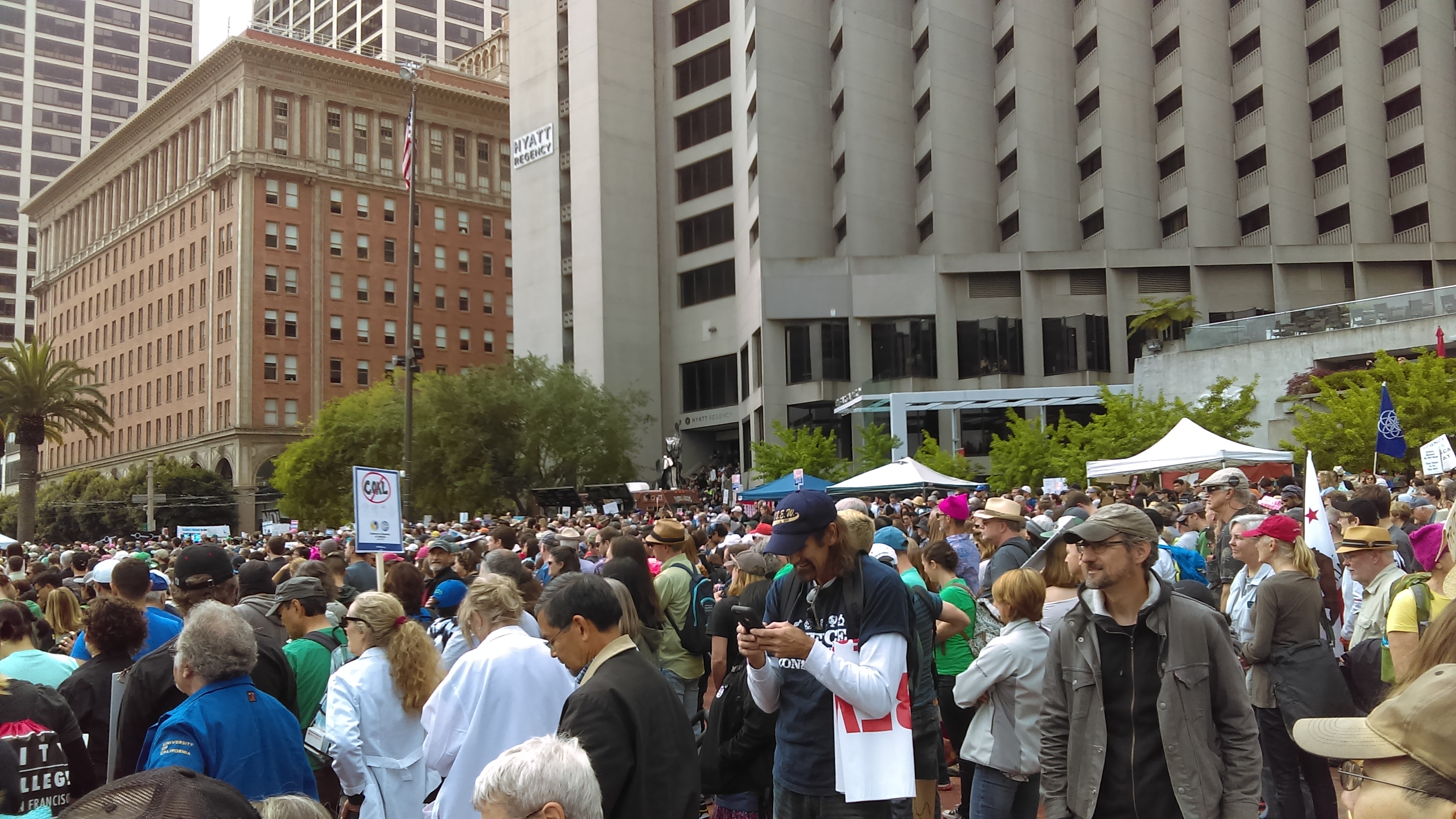
I write this four days after the March for Science, and three days after Yameen Rasheed, a human rights focused secular blogger in the Maldives, was murdered.

What to make of all this.

I happily participated in the March for Science with my local Sunday Assembly community, and was heartened to see several, well worn, yellow "Standing on the Side of Love" t-shirts throughout the crowd. The East Bay Atheists, the Kol Hadash Humanistic Jewish Community, the Center for Inquiry, and the Bay Area Humanists were also proud and present, as was a big contingent from San Francisco's Grace Cathedral - with big "Grace for All" signs.

While "listening" to speakers before the March (Can you ever really hear them?), one of our Sunday Assembly members recounted a story from the novel Catch 22- a bit macabre - involving the mix up of a catheter and an IV. "It's crazy!" he recounted, "and when I see what's going on, I just want to shout "This is crazy!"

I enjoyed the look of passer-by on the street, almost overwhelmingly either a smile and thumbs up support, or blissful avoidance.

One in our group remarked, "I always don't feel like going to these things the morning of, but when I make myself go, I'm always so glad I did."

I want to carry that resilience with me in the days ahead. That can-do-ism, even when we don't always want to in the short term, can create bigger, more positive results for all us. Our small and mighty humanist communities here in the US are potential life lines and allies to these secular justice seekers and advocates for rational policy, not just here in the US, but overseas.

Initiatives like Secular Rescue assist humanists in exile from violent circumstances in their home countries, and could easily be a recipient of revenue from a potluck fundraiser or "Share the Plate" collection. There may be initiatives through the UUA or UUSC to support atheists and humanists in danger overseas, though I'm not sure what they are.

As Unitarian Universalists and Humanists, we showed up for the March for Science, and will continue to show up for evidence-based policies. Let's show up and support our humanist sisters and brothers overseas - some face death for simply raising questions.

Daniel Lawlor
San Francisco, CA

  Read more about Keep the Resilience »

Categories: 

Not Just Mourners

Last summer, there was terrible violence in South Carolina. 9 individuals, 9 black Americans, were shot dead by a deranged terrorist in their church. There was outcry. Preachers and leaders promised change - or, at least, held up the communities of concern that formed out of pain.

Now, a year later, across the country there are communities of concern that have gathered in response to pain. This time, 49 individuals, LGBT Americans, many Latino, were shot dead by a deranged terrorist in an LGBT Club. 49 murdered, 53 wounded. 

Just a few days ago, here in Oakland, a young girl was shot dead after leaving a funeral. 

What do we do in response to these murders? What does our movement, religious and secular, do in response?

Some people, when pain happens, need to be alone, or with one person. 

When I heard the news, I craved community. I wanted to be around others, I wanted to see and contribute and be with other people trying to do something- even if initially it was only a witness. 

I went to the Castro neighborhood in San Francisco. Honestly, I had no idea how many people would be there. There were thousands. Thousands of people- gay, straight, young, old, atheists, doubters, and believers- who stood for love. 

There was a common thread and that was to, "Remember the dead, and fight for the living." Or, as one participant shouted, "Out of the apartments, and into the streets!" 

In words, however inadequate, with humor, with song, with tears, people shouted, cried, argued, laughed, danced, and marched in testament and practice to a better way of living. 

The too long history of violence against LGBT people - even in San Francisco - was called up - from the burning of the pioneering LGBT proud Metropolitan Church in the 1970s, to City Supervisor Harvey Milk's assassination, to the AIDS epidemic and public health neglect, from the successful battles for legal recognition and the struggles of homelessness today, San Francisco gathered to witness.

Tom Ammiano, a legendary San Francisco progressive and the first openly gay teacher in the city spoke to the crowd. He said, roughly, “I am old and full of gay blood, but we are going to fight back...This started over a kiss, a beautiful, beautiful kiss. I'm done with lasiezz faire homophobia- the "It's fine if you're gay, but I don't want to see you..." Forget that! We need to do better - today." To make his point, Ammiano kissed Mayor Ed Lee. 

As people of goodwill, we have to ask ourselves, what can our communities do, here and now, to support and grow and create caring, welcoming spaces- and to push for changes that will help more people heal, and that fosters a bigger, inclusive civic community. 

A friend wrote, "I find it sad that it seems always to take massive visible death to elicit somewhat political responses from groups filled with conscious well meaning people.  Non profit status should not so hamper responsible action."

We are part of gathered communities, religious and secular. What can we do to be more intentional with how we already use our resources and time to foster the world we want to see? What can our movements do to make ourselves not just mourners, but participants in building something better? 


Daniel Braga-Lawlor
Berkeley, CA Read more about Not Just Mourners »

Categories: 

Humanists Doing Good

By Daniel Braga-Lawlor 

Sunday Assembly is a negotiated community, a network of secular congregations across the world, primarily in Western Europe, North America, South Africa, and Australia. The dominant, though occasionally debated, ethos in Sunday Assembly is faith-neutral secularism ("Let's celebrate the one life we have! We don't do deity, but we won't tell you you're wrong if you do!"). 

Sunday Assemblies organize a monthly celebration, have no official text, no clergy (we rotate hosts for our Sunday celebrations), and each community has great latitude in selecting its speakers, songs and readings, as well as defining the local service work. The songs we sing are not hymns, but come from across pop music - in Northern California, we've sung "Superstition," by Stevie Wonder, "Lean On Me," by Bill Whithers, "Both Sides Now" by Joni Mitchell, "Time after Time," by Cyndi Lauper, and many others. We operate from the premise that knowledge from across the fields (arts, sciences, economics, ethics) offers insights, and that all people, as believers and non- believers alike, matter.

Initially, Sunday Assemblies received press and were billed as "godless congregations." At the first international gathering of Assemblies, held in May 2015 in Atlanta, Georgia, the accredited assemblies voted to change the language from "godless" to "secular" to more fully embrace the living, breathing diversity of who attends: atheist, agnostic, freethinker, spiritual not religious, and those who identify with a religious tradition but find Sunday Assembly of value. 

Regardless of our labels, volunteer service is a touchstone of Sunday Assembly work. Just as Unitarian Universalist communities gather both for worship and outward engagement, Sunday Assemblies create monthly community celebrations and seek to offer ways to become involved, as a group, in their wider neighborhood and world.  

At our chapter, Sunday Assembly East Bay (the Oakland-Berkeley area in Northern California), our most consistent community work is monthly singing with seniors at a nursing home in Berkeley. For us, the call to recognize this is the one life we know have, encourages active engagement with the people in it. 

This service group started about nine months ago thanks to the imagination of Debra Wong, a teacher in our group, and has turned into a regular practice. At last month's senior sing, 9 people joined us, up from our early days of 3 to 5 people. 

In the nursing facility, we interact with about two dozen people in the twilight of their lives. Yet there still so much life in that room. I have seen people, contorted and with heads hung, begin tapping their fingers and smiling when they hear a song from their youth. I have seen wonder. 

One woman at the facility, Marie, who always has a beautiful knit quilt (orange and black hues) has a special care in her eyes. The first time I met Marie, I asked her what she thought of us, she nodded her head and said, "You're not that good, but I'm glad you came!" 

A few months later, she said, "You're pretty good!" 

Now, after much more practice, she said "It's beautiful!" 

Marie particularly loves when we sing "Proud Mary," either inspired by Clearance Clearwater Revival (Go El Cerrito!) or Tina Turner. 

Primarily, we sing- in a group- karaoke style- oldies- music primarily from the 40s, 50s and 60s - with the occasional songs from the 1930s or 1990s for good mix.

"When Irish Eyes are Smiling," is a hit, Elvis' "Can't help Falling in Love," and a sweet, Broadway-style number "You come from Rhode Island!" which tells a joke or two about most US states (but not Ohio, as one attendee, Francis reminds us). 

One woman at the home, Kay, with beautiful purple glasses, told me, "What you do, when you sing, you take us to places we can't go anymore. We remember. Thank you." 

This type of direct engagement is one that I have found so life-affirming. Regardless of congregational or Assembly labels, the need for human connection, especially with and across elders in our community, is vital to foster a culture that is grounded in compassion. 

We can negotiate on terms, but the focus on the one life we have, and what to do with it, remains a consistent opportunity for all secular congregations. Read more about Humanists Doing Good »

Categories: