Posts by Maria Greene

SOAP for the Holidays and the New Year

A feature of food pantries in December is the distribution of groceries tied not only to day to day survival, but also to the provision of a festive holiday meal. Client counts rise, lines grow longer, as do the volunteer lists. An added feature this year at the Maple Park/Morgan Park community Food Pantry on Chicago's Southwest side is environmentally friendly dish washing soap. Fully recyclable dispensers of non-toxic, biodegradable Method soap, manufactured in a LEED platinum certified factory just a few miles away are handed out (separately bagged as per health regulations) along with the turkey's, yams, cranberries and other seasonal staples. The first delivery of 100 18 oz bottles was made on December 8, by Roger Brewin (who helped set up the pantry more than 30 years ago) on behalf of UU Humanists.

The SOAP (Save Our Ailing Planet) project was designed as part of UU Humanists' participation in Commit2Respond, (www.Commit2Respond.org) a UU initiative designed to grow the Climate Change Movement, increase reliance on renewable power, and reach out in the process to marginalized communities, often disproportionately effected by a warming planet. The Method factory is completely wind and solar powered, and the clients and many of the volunteers for the pantry are from economically disadvantaged areas of Chicago (as is much of the factory workforce). 

Brewin sees the project as an entry-level-to-climate activism opportunity, with individuals able to participate through donating the cost of one or more bottles of soap, helping to promote the project in their own congregations or humanist groups, and assisting with the collection of donations and delivery of the soap to local pantries and shelters. Congregations and groups willing to replicate the collection and distribution process in their own communities can contact Brewin at 773 551 8540 or Rabrewin@aol.com to receive starter kit. The program starts small, and can fit in with existing work in a Green Sanctuary program, a small group ministry or a religious education social justice curriculum.   

Sufficient donations have been received since the project started just before the 2015 GA, that UU Humanists can now offer a matching grant of 25 bottles to each of the first four groups/congregations that raise enough money for 25 bottles for a pantry or shelter in their own community. Read more about SOAP for the Holidays and the New Year »

Categories: 

Welcoming the Closeted

[Editor's note: this is the first of a new monthly column that Rev. David J. Miller is writing for the UU Church of Worcester, MA, where he is Minister Emeritus.]

If we truly wish to make people, and especially minorities, feel welcome in our congregation, it is not enough to sloganize “All Are Welcome!”  People will feel welcomed when we greet them by name as Pope Francis did in the course of his recent speech in Washington, when he asked his audience to pray for him and added, "And those who are not believers and cannot pray, please send me your good wishes."

Many non-believers hunger for the kind of recognition and inclusion represented by Pope Francis’ words.

In contrast, not so long ago a family member said to us in reference to our Humanism: “You are the kind of people who are ruining our nation.”

And I know a young man who was thrown out of his family home while still a teenager when he told his parents that he no longer believed in God.

And I know a person who was fired from his job when it became known that he was a non-believer.

To come out to one’s family as a non-believer may be to risk judgment, condemnation, rejection, and/or ostracism.

To come out as a non-believer in one’s workplace may be to risk discrimination or losing one’s job.

To come out as a non-believer while holding public office may risk political suicide.

And so, many Humanists, Atheists, Agnostics, and Freethinkers remain closeted because it is risky for them to reveal their religious/philosophical/life stance views.

I consider myself fortunate to have discovered UU churches as a teenager and to have a career as a UU minister: beyond the walls of the UU churches in my life, I have been largely closeted.  In the larger community, I have been reticent about revealing my true views on theological issues; but, in UU circles, I could be open and forthright about who I am and what I believe.

At its best, our church is the place where we can hear our names (Humanist, Atheist, Agnostic, Freethinker, or for that matter, Jew, Muslim, Hindu, Buddhist, Pagan, Theist, or Christian-who am I forgetting?) pronounced in tones of respect, acceptance, and friendship.

And especially for religious non-conformists, our church is an oasis amid the storm of passionate denunciation of non-believers that emanates from various outspoken religious and political leaders and news channels.

Now, as we reach out to the surrounding community with the aim of increasing the membership and strength of our congregation, I find myself wondering, “How can we reach out with a welcome to the non-believers in our larger community who hunger for the kind of recognition and acceptance that we know how to give?”


Rev. David J. Miller, Minister Emeritus
November 5, 2015 Read more about Welcoming the Closeted »

Categories: 

The Naturalism Discussion: Moving Beyond the Humanist / Theist Debate

People are more important than beliefs.* Some may consider this a corollary to the first Unitarian Universalist principle, “The inherent worth and dignity of every person”, or the third, “Acceptance of one another and encouragement to spiritual growth in our congregations [and beyond].” We are Unitarian Universalists because we choose to be in community with one another. So, let me rephrase that slightly: relationships are more important than beliefs.

I've published a few essays recently about my perception of the place of humanism in the Unitarian Universalist Association. Many of the comment threads on those essays and on Facebook have been enlightening, and engaging with my fellow UUs in all of them has been a privilege. The essays also prompted at least one response in another blog. I realize now that I made some unexplained assumptions in those essays and that others have made assumptions about me and about humanists in general so that we are sometimes talking past one another. The summary of this recent engagement and reflection on it leads to the thesis of this post: Unitarian Universalism is moving beyond the humanist/theist debates and is transitioning to a discussion about naturalism.

First, indulge me while I get a little analytical. Not all humanists are analytical by nature, in spite of what some may think, but I admit to being guilty as charged. (Note that I say that jokingly just in case it is hard to tell in this medium. Some humanists have a sense of humor too!)

One of the assumptions I have been making that may be wrong is that we are using the same definitions of humanist, theist, atheist, agnostic, and naturalist. Before I get into this, I do have to apologize to those who are uncomfortable with labels. I agree that labeling is often a barrier to understanding because it sets up false circles around people that include or exclude, but I maintain that it is OK to self-identify based on your worldview while keeping in mind that we are all UUs and that relationships are more important than belief. As we tell our coming of age young people, it is fine work to clarify your worldview and to be able to express it clearly, as in a credo.

In this essay, I’m going to define a humanist as a naturalist who has a particular interest in ethics and human and societal flourishing. Yes, being a naturalist means our worldview is without gods, which is the definition of atheism (“without theism”, not “against theism”) so I am going to use the word atheist even though many UU humanists do not self-identify as atheists. Just to make everyone potentially equally annoyed, I’m going to contrast naturalist with supernaturalist, and use the latter to refer to someone who believes in any entities, forces, or experiences that are outside of nature. Then I’m going to substitute the word theist even though I know there are many examples of supernatural beliefs (like animism, karma, and panentheism) that don’t require or imply belief in a personal God or gods. I’m going to try to avoid using secular/religious entirely though I observe that the wider culture commonly uses them as replacements for both atheist/theist and naturalist/supernaturalist.

I observe that there’s an atheist / theist scale representing how strong your belief is that there is no meaningful god concept up to your belief in a very traditional, Western concept of a personal God (or gods) who rules over the universe, can perform miracles, and intervenes in the affairs of people. Similarly, I’m going to propose, or more accurately share and modify what other people propose, that there is an orthogonal agnostic / gnostic scale that reflects how firmly you feel you know your position is true. An agnostic does not claim to be certain, a gnostic does feel certain. If you put the two scales together, you get a graph like the following:
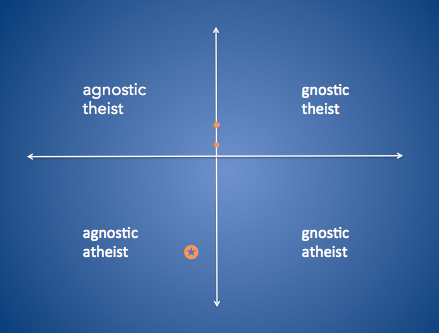
belief-knowledge space

It’s my observation that most UUs fall on the agnostic side (we fall to the left, what a surprise!) There are certainly gnostics in our community, both atheists and theists, but being open minded is the norm and the expectation. I also need to point out the obvious that a person’s point is not fixed over time. Some trace a path that covers a large distance on this graph and others just oscillate around a point. One person’s location may move slowly (or never move at all) and another’s might shift quickly, which is often traumatic and disorienting. There is also not necessarily any right or wrong direction on this graph unless you consider “towards my position” as right and any other direction as wrong. (Many people disagree strongly with me on this point, I know, and I enjoy listening to their reasoning. For me, the only part of the graph I have a problem with is the extreme right edge, particularly the top.) Finally, it’s useful to note that some people’s point is fuzzy because they don’t care enough about the question to decide where they stand; they are “apatheists” a portmanteau of “apathy” and “theist”, or just haven’t settled on a position. Others reject the whole model, Sherwin Wine called them “ignostics”, saying the question is not meaningful because “every theological position assumes too much about the concept of God”.

The difference between this graph and the ones in the references above is that they show binaries: you are either an atheist or a theist, you are either gnostic or agnostic. It’s an important part of my point that people are not binary; there is no black and white, there are scales of belief and confidence in knowledge. This means the star representing my position is in the agnostic side of atheism, but not too far from the (weak) gnostic side. I am fairly far from calling myself a theist. Even though I understand the reasoning of people who go just over the line and remain naturalists, I do not find it helpful to my "spiritual growth" to go in that direction (toward using theistic language to describe my naturalism). In fact, I have a problem with the term "spiritual growth" for this reason -- those who do use religious language think of spiritual growth as upward on this graph. As I said before, this is because it is natural to think of the "right" direction to move on this scale as toward your position. I would point out that many atheists consider theirs a more "mature" position, so moving down on the graph would be "spiritual growth" for them, though, being allergic to even quasi-religious language, they probably would not phrase it that way.

What I want to highlight on this graph is that the interesting point on the up-down axis isn’t the center, which divides self-identified atheists from self-identified theists. The interesting point to me is what I call the natural/supernatural point, which is up above the center (I've marked it with an orange dot). There are some UUs whose conception of divinity or “the sacred” is poorly described by the humanist (equated with atheist) / theist dichotomy. What puts them over the line is style – they find the language of theism more descriptive of or compatible with their position. (They prefer “night language”, to use Michael Dowd’s phrase.) If you ask them to describe what they mean by God or any other theistic concept, the response is naturalistic -- it is poetry that draws them above the line. They may describe themselves as pantheists. People on either extreme may try to use the “no true Scotsman” fallacy to push people off of their side, but this is a graph for self-identification. I’ll also note another important point further up the up-down axis: this is roughly the panentheist position (that I've maked with an orange triangle).

If we could have a scatter plot of UUs on this graph, I contend that a great majority of us would fall fairly low and to the left. Obviously, there is no UU circle or other shape on this graph that you are either inside of or outside of – that would require a creed – however, there is a center of gravity. Like an individual’s point, that center of gravity can and does shift. This is all just a thought experiment because I know of no scale that could be applied to these axes. Ultra-orthodox religions would cluster in the top right and New Atheists would be close to the bottom right (but probably not as close to the right, strong gnostic edge, because of the part of the scientific method about being willing to revise your beliefs based on strong evidence). I think there is widespread agreement that most UUs fall below the point on the theism scale where our values come from humanistic concerns, rather from a perceived need to please a God or gods or to avoid punishment in an afterlife.

Some of you are still uncomfortable with me pointing out these differences between us and question my motives. I want to point out that it is OK to criticize ideas but it’s not OK to criticize people. The Unitarians certainly had no problem with criticizing the idea of the trinity. The Universalists certainly had no problem with criticizing the idea of eternal punishment. As a humanist, I do criticize the idea of something beyond nature and I defend the idea that nature is enough, because nature includes complex human nature that encompasses imagination and deep emotions like love and compassion. It also includes other intangibles like hope and justice. Part of that human nature is defensiveness and I can understand how some who believe in something that transcends nature would interpret disagreement with that concept as criticizing them as people. I do not think it is important for all to believe as I do (that there are no forces, entities, or experiences outside of nature), but I do think it is important for others to understand why I believe it and to not disrespect or make assumptions about me because of it. (And my reason is very simple: I don’t see a need for anything else, never mind any indication.)

It came across in the comment threads that some theists act as if humanism only encompasses science and reason, not just that it values science and reason. I think it is true that some humanists overvalue science and reason; we call this scientism, and I criticize that idea as well. Conversely, it has come up that some UUs think (or perceive others as thinking) that any expression of theism, even the ones in the humanistic range, are ignorant and are a rejection of critical thinking. It was pointed out that I (and the UU Humanist Association) don’t criticize those stances publicly as often as I (we) should and I agree. While I do think there is an actual, important difference between naturalism and supernaturalism, there is no difference in human nature of people on either side of that point on the belief scale and we are all clustered so closely together on bigger issues that have actual moral implication, it is a shame to waste energy on debating. Rather than debate, I’d prefer to have a discussion with you about what experiences you have had or things that you value that make you believe in the supernatural. Or just hang out with you and drink coffee.

So, why do I write articles expressing disappointment about implied slights to UU humanism? I will write more about that later, but the simple answer is because otherwise you are going to lose me and people like me. You are also going to fail to attract a large segment of the population that has rejected traditional, organized religion but that is looking for community. The UU Humanist Association has a new program, the Freethinker Friendly congregations program, that I think will be helpful in making space for humanists in congregations in a way that enriches all. We all agree that this is not a zero sum game. It does require engagement and discussion, but I think we can all agree that we are past the need for an atheist / theist debate.

So I hope that the discussion so far has illustrated what I think is the common understanding among UUs that the humanist / theist distinction is a false dichotomy. I also hope it has helped situate UUs as clustered close together on the scale of atheism / theism in the wider culture and made the point that you can be a naturalist as both a humanist and a theist, and, more importantly, that you can adopt a humanistic ethic even while accepting some supernaturalist beliefs. And, though I didn’t make any arguments in its defense because I think it is obvious, let me restate my opening premise: relationships are more important than beliefs.

* This is a nod to the Oasis Network, a new model of humanist community. “People Are More Important than Beliefs” is their first value.

Pansy image credit: "Pansy aka" by André Karwath aka Aka - Own work. Licensed under CC BY-SA 2.5 via Wikimedia Commons. Why a pansy? Because they are the symbol of freethought and because it is pretty. Read more about The Naturalism Discussion: Moving Beyond the Humanist / Theist Debate »

Categories: 

Wrap-Up of the 2015 General Assembly in Portland, OR: Building a New Way

The 2015 UUA General Assembly is over now and we are finishing tallying up, following up, and evaluating how it went and what we will do differently next year. GA is always a fantastic time to connect with each other in person and to introduce the Association to a whole new group of UUs.

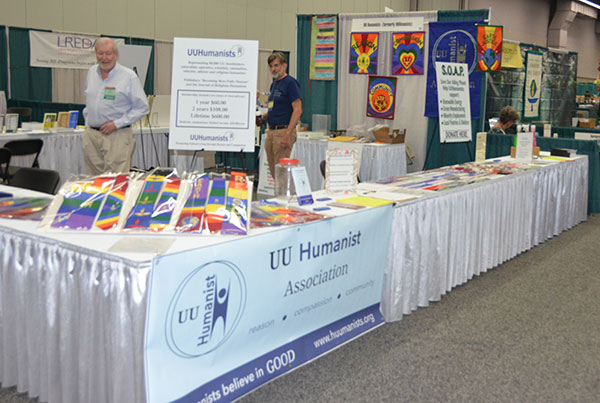
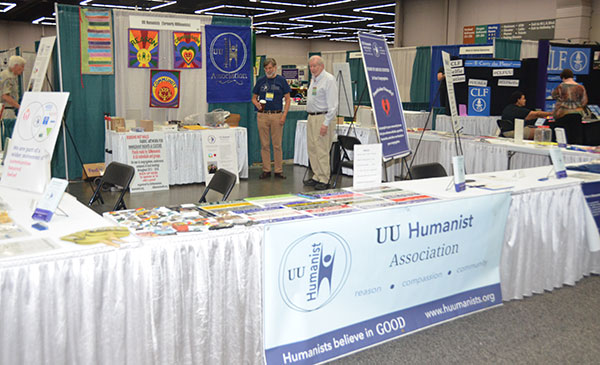
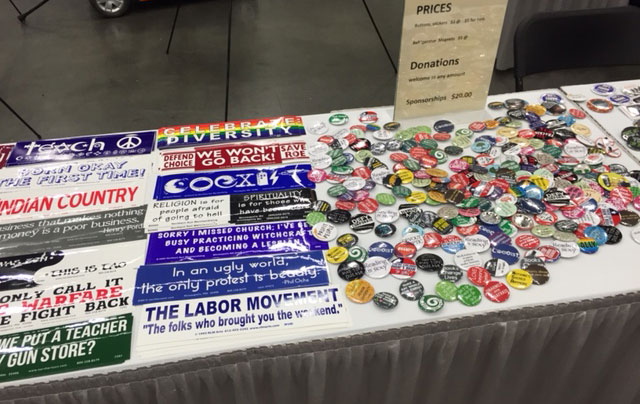
Our booth in the Exhibit Hall could not have been in a better location -- at the end of an aisle directly across from the entrance doors. As usual, Roger Brewin, in the light blue shirt in the picture below, did a yeoman's job planning, setting up, and later tearing down the booth. Click on the picture below for several more shots showing the different displays on the tables.

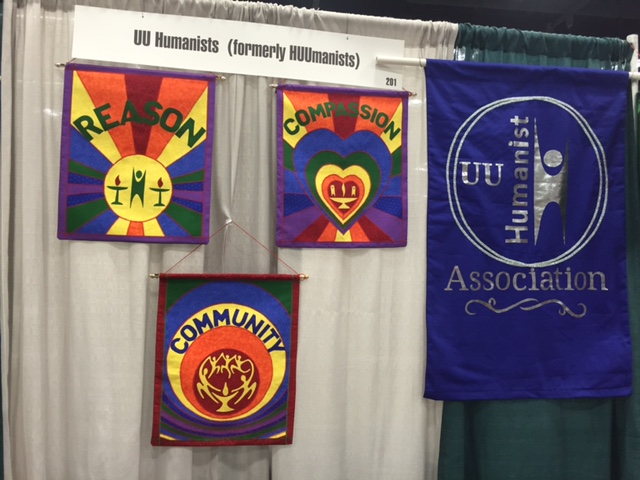
Featured in the booth were the usual "eye candy", as Roger calls it, which included bumper stickers, pins, and magnets as well as, new this year, rainbow-hued ties, stoles, and banners with humanist and UU symbols, donated to us by member and friend Rev. Jim McConnell. Given the fantastic news we received in the midst of GA about the Supreme Court ruling on same sex marriage, those were a big hit and sold out fast!

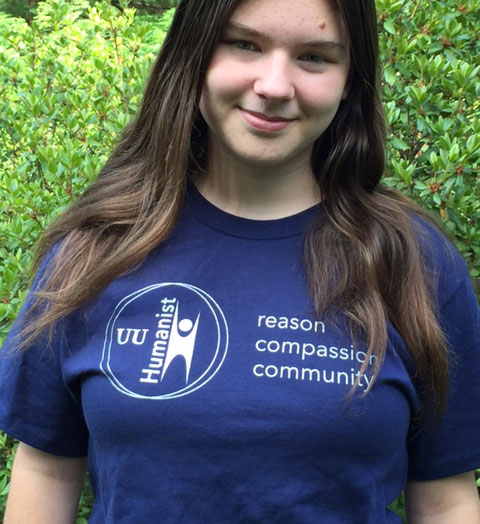
The booth also featured displays about the new Freethinker Friendly congregation program, the S.O.A.P. environmental justice project, various books (most from our own press) and our journal for sale, UU Humanist t-shirts, and a few panels from the Ribbons Not Walls immigration rights / banned books project featuring a panel made by our Religious Humanist of the Year award recipient, Kendyl Gibbons.

Over the course of the week, we signed up almost 100 new or renewing members, sold a lot of fun and provocative merchandise, and had hundreds of fascinating conversations with UUs about humanism in their lives and congregations.

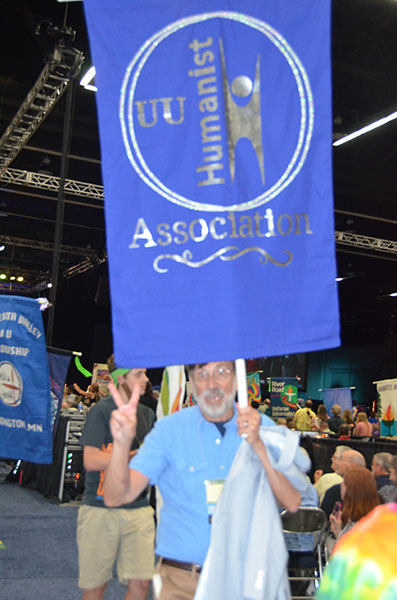
It was a banner year in another way -- we now have a banner! President John Hooper carried our banner in the parade during the Opening Celebration on the first day. We also displayed the banner in the booth all week and during our events.
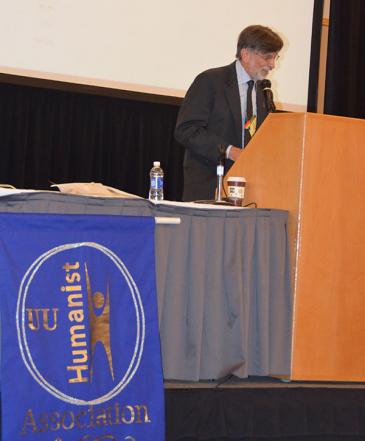
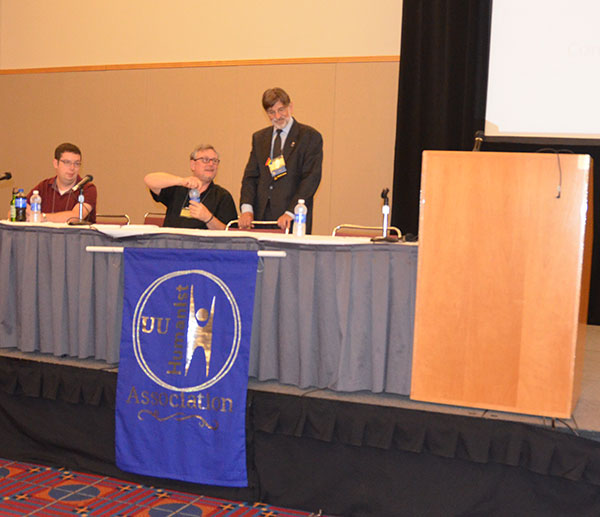
On Friday, we came together for the program we arranged, "Serving the Nonreligious", then for our Annual Meeting and presentation of our yearly award. After the formal meeting, many of us hung around enjoying the refreshments and strategizing ways to involve more of the members from the west coast and how to work with related organizations.

While at GA we also attended many interesting programs, particularly in the Innovation and Growth topical track learning about developments like multisite and emerging ministries, and in the #blacklivesmatter and #commit2respond climate justice tracks. As usual, the worship services were inspiring but sometimes uncomfortable, at least for me. We encourage all who went to GA to use the GA Attendee Feedback survey to express their honest opinion. The Ware Lecture with Dr. Cornel West and the #blacklivesmatter demonstration were highlights, as was the spontaneous marriage equality celebration.

We owe a big thank you to all the board members who attended and helped out, to our members Warren Wylie, Chris Schriner, and Jack Reich who spent many hours in the booth, to our speakers David Breeden and Kevin Jagoe (both of whom are now on the board as well), and to the UU Community Church of Washington County that lent us a projector (and saved us several hundred dollars in rental fees).

We've started planning already for next year's GA in Columbus, OH. While we await details about the theme of GA '16, we've already decided to focus our outreach on Positive Humanism and to grapple with the interesting topic of Humanist "Spirituality". We look forward to continued engagement with the extended UU community! Read more about Wrap-Up of the 2015 General Assembly in Portland, OR: Building a New Way »

Categories: 

Introducing the Freethinker Friendly Program

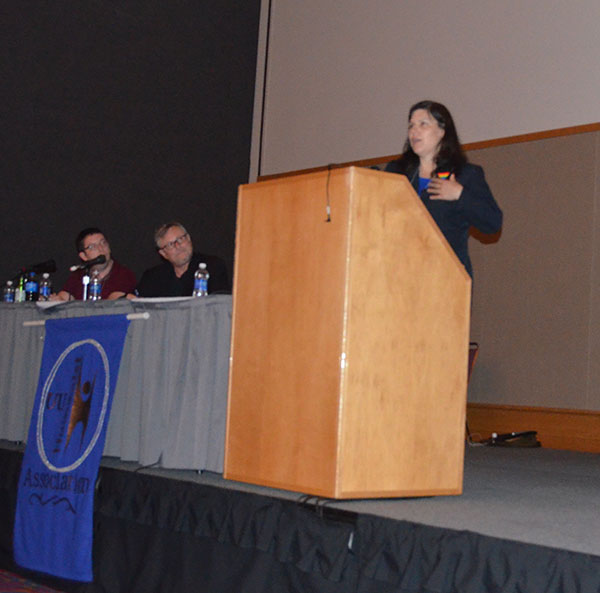
This is my presentation from the "Freethinker Friendly" part of the "Serving the Nonreligious" program at the 2015 UUA General Assembly in Portland, OR on Friday, June 26. I am Maria Greene, the part-time Executive Director of the UU Humanist Association.

Freethinker Friendly is a program of the UU Humanist Association with the goal of helping congregations communicate to their communities that they are welcoming to atheist, agnostic, humanist, and other freethinkers. You can find out more about the program and register your interest on the Programs > Freethinker Friendly page of this website.

Listen to the Presentation

[A special thank you to Adam Gonnerman for creating the video version of this presentation.]

View the Slides

 FFPresentation.pdf Read more about Introducing the Freethinker Friendly Program »

Categories: 
Tags: 

Humanists ARE Joiners!!

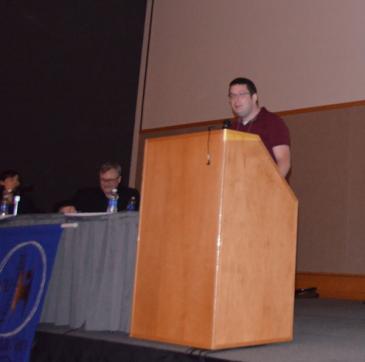
This is Kevin Jagoe's part of the "Serving the Nonreligious" talk at the 2015 UUA General Assembly in Portland, OR on Friday, June 26. Kevin is the Media Coordinator and Youth Director at First Unitarian Society, Minneapolis and the newly-elected Member-at-Large of the board of the UU Humanist Association.

In this presentation, Kevin discusses the outreach efforts he is involved with at FUS, and encourages other UU congregations to offer things that humanists and other freethinkers are truly interested in.

Listen to the Presentation

[A special thank you to Adam Gonnerman for creating the video version of this presentation.]

View the Slides

 Humanists ARE Joiners.pdf Read more about Humanists ARE Joiners!! »

Categories: 
Tags: 

UUA, Why Aren't You Nurturing My Spirit?

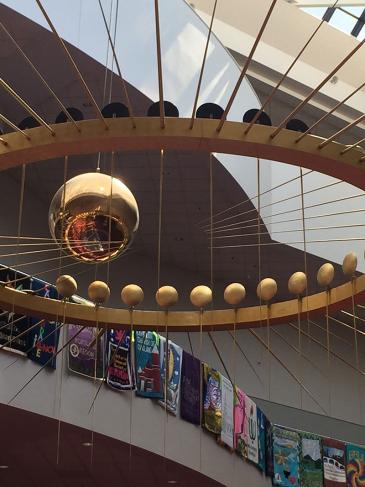
I laughed out loud yesterday when I got to the bottom of the stairs at the Oregon Convention Center for General Assembly and I saw the giant pendulum swinging in the foyer. Pendulums come up often when I'm discussing the place of humanism in the UUA with the people who come by the UU Humanists' booth in the exhibit hall. In the past, I'm told (since I am a new Unitarian Universalist and wasn't there to see for myself) the pendulum swung toward humanism, and now I'm told (and I see for myself) that it is swinging toward theism. The slow, relentless swing of the gold ball in the foyer is mesmerizing and the force must be tremendous, but I say it's time to stop the pendulum's swing entirely.

I just came from the Service of the Living Tradition celebration where the wonderful Marlin Lavanhar gave the sermon. Through the also wonderful power of YouTube, I feel like I know Marlin since I have watched him speak many times in the videos put up by All Souls Tulsa, where he is the senior minister. He also was one of our speakers last year for the UUHA GA program on how to create Sunday services that embrace the diversity of religious thought in our congregations. All Souls Tulsa has weekly services in three different styles to create the right nurturing environment for its humanist UUs, more traditionally religious UUs, and newly integrated Pentecostal UUs, while realizing that people don't fit into boxes and encouraging participation across and between.

The major message of the Service of the Living Tradition sermon was that we need to allow our people to be authentic and express their sincerely held beliefs. Yes, I said to myself as I applauded with the rest. This is only my third General Assembly, and I've gotten this message loud and clear many, many times in GA sessions and services. I've read this message in UU World, and UUA blogs, and on The VUU, the UUA/Church of the Larger Fellowship's on-line talk show. I've heard this message directly from senior UU staffers in Boston when we've met to talk about outreach to nontheists. Yes, we need to allow people to bring their authentic selves to their Unitarian Universalist community. Yes, feeling the need to hide part of your identity is being in the closet, and that is oppression.

Being a nontheist in America, I've used that analogy to LGBTQ experience many times. I've pointed to public opinion surveys that show that atheists are now the most distrusted minority, surpassing gays and lesbians, Muslims, and sometimes even rapists in polls. Fearing and hating atheists is irrational but it is socially acceptable. While I point out that this distrust does not generally result in the level of discrimination and oppression faced by many other minorities, it is still very real. This causes many, if not most atheists to hide their identity and stay in the closet. In some conservative parts of the country this is necessary to keep your job, your apartment, or sometimes even your family relationships. Think about that; sometimes people value their need for others to share their religious faith more than they value their relationship with their spouses or their children. Or put another way, sometimes people are so tribalistic and uncomfortable with difference that it can dissolve love itself, usually the most powerful force in human nature.

But wait! In Marlin's story and the UUA's story, I am the oppressor. I am his oppressor because he did not feel comfortable being open about his authentic self. What is wrong with Unitarian Universalism and what is holding us back from growth is our failure to embrace those who embrace God. Wow! I've heard second hand of ministers saying, "If we just wait for all those old humanist dinosaurs to die off, Unitarian Universalism will be free at last," but I never gave much credence to those stories or I dismissed them as the easily-ignored opinion of a small minority who are outside of the true spirit of UUA inclusivity. I know, with certainty, that Marlin Lavanhar does not feel that way, but yet I've heard both humanists and theists describe the other as "the problem" with the obvious implied solution.

When I discovered Unitarian Universalism after decades of being a "None", I was amazed and happy. It truly was amazing to this former Catholic -- a place where I could take my authentic self and my Humanist family and be loved and supported in ways that I thought were only available to theists or others who could accept the supernatural. I was indignant that I had lived so close to my current congregation for a decade but had been unaware that we would be welcomed there, to the extent that now I work for the UU Humanists trying to get other congregations to be better at communicating that welcome. Unitarian Universalist congregations are the only places in most parts of the country where that is true. But by celebrating that and seeking to broaden and communicate that, I am the problem with Unitarian Universalism!

UUA, where is the nurturing of my spirit? How do you help me deal with those fears that Marlin enumerated so well last night? I don't have belief in a higher power that is going to right the wrongs and wash away the pain using superpowers. I wish I did and I can fully understand why people do because life is hard for everyone, as the sermon pointed out. Grief touches everyone eventually, even the white, middle class, NPR-listening, privileged UUs. So, where are the GA sessions on Grief Beyond Belief? Where are the services that take their inspiration from our creation story, the universe story, and the truth that we are star stuff and part of a grand, magnificent, messy, wondrous, interconnected world? Where is the advice for what to tell my son when he can't sleep because he's afraid that he is going to die some day, or that I might die and leave him alone? Where is the training in UU seminaries of how to minister to people like me who need to rely on human hands and human love to find hope and purpose? Where is the sense of mission to reach out to people like me who have nowhere else to turn for solace and inspiration and community because we don't fit the religious norm? Where is the joy, and the celebration of life and love from a humanist perspective?

There are hundreds of thousands of Christian churches in America and plenty of other houses of worship for every imaginable form of religious thought. Some of them, like our friends at the United Church of Christ, are almost as liberal as we are and will welcome you even in your doubt or disbelief. They see the changes in society too and they know they need to broaden their perspective or fade into irrelevancy. They are making spaces without organs and pews, hymns and sermons, where people who do not respond to traditional religious forms and norms can still get their human needs met. We are not unique in embracing people where they are. But we are unique in embracing people where they are not, or at least we were.

There are new nontheistic "un-churches" springing up like wildflowers: Sunday Assemblies and Oases and Humanist Hubs that are joining the Ethical Societies and Humanistic Jewish communities that already dot the landscape. There is a new awakening in the secular movement that you need in-person community to become more fully human and to effectively serve the world. There's a hunger for experiences of celebration of life and ceremonies to add meaning to important life milestones in ways that used to be provided by religious institutions. The place that Unitarian Universalism used to play in the secular movement is being replaced by these new institutions because the UUA does not communicate that we want to be that anymore and when it tries, it does not do it well; it still feels like church. And when it doesn't feel like church it is too cerebral which makes modern nontheists still feel like they don't belong.

You are not serving my needs, UUA, by having the only two options be gospel or classical, speaking in tongues or reading a science journal, listening to a sermon or listening to NPR. Where is the nurturing of my spirit that is in my language of poetry and nature and human relation that isn't based on traditional religious words and symbols that have no meaning for me? Don't tell me that it is my issue or my millennial children's that we can't use God language metaphorically. That does not do it for me or for them. I resonate with Marlin's story of losing a child and how that universal, primal, human feeling of grief unites us across our mere differences in belief about natural vs. supernatural. But how do you help me deal with that when I can't turn to the solace of the hope that they may be "on the other side" where I might meet them again? Even most "believers" in our UU congregations remain at best agnostic about that possibility, so how do you help us deal with big questions when you know there are no absolute answers?

It is difficult to be all things to all people and our focus on Humanism and reason has, in the past, truly made theists feel they don't belong -- and that is not right. If embracing our religious, churchy side solves that problem and that is the problem you want to solve, then do it and do it well. If you wish to be the church for theists who are not necessarily Christians, then be that fully and stop blaming me and my fellow Humanists for keeping you in the closet. Better yet, and I don't mean this snarkily because I really love and admire them, merge with the United Church of Christ and broaden their liberal religious mission even further. Let theists breathe a sigh of relief and fully express themselves. But be honest about that and let me go find my community elsewhere. My authentic self is different from Marlin's authentic self. My authentic self says my creation story is the universe story; my authentic self says the only "super" power is love and it is not supernatural, it is woven through and embedded in human nature; my authentic self says embracing reality doesn't mean sacrificing meaning and beauty. But if the Unitarian Univeralist Association as an institution is not interested in developing the kinds of communities that meet the needs of people like me then clear the dance floor and let someone else dance. I promise to not step on your toes anymore.

Now, I could leave it at that because that seems like a good concluding paragraph, but that would be wrong because it reads like an ultimatum and the fact is that humanism and humanists are too fully embedded in the DNA of Unitarian Universalism to have us step away. And Unitarian Universalism is not just the UUA institution, it is an association of congregations full of people in relationship with one another across their diversity, with a deep sense of shared ownership and shared history. And we are not going away. The ones that have not already left are the flexible ones or the ones with deep roots. One solution to the problem of fully meeting the needs of a diverse group of people is modeled by Marlin himself and his All Souls Unitarian Church Tulsa: make space for one another. Don't try to be all things to all people all the time. Be open, honest, and respectful about our differences and don't try to do away with them or ignore them. Engage with our diversity and try new ways to serve those diverse people.

The UUA is focused on "Finding a New Way" (beyond that just being the theme of this year's GA) and experimenting with new models. Unitarian Universalism's uniqueness is no longer just its non-creedalism which is being adopted as the next step beyond nondenominationalism by many liberal religions. Unitarian Universalism's true uniqueness is in its longstanding embrace of nontheism. But our old ways of expressing that are no longer effective; we don't just want additional services where the God language is crossed out and replaced with fuzzier religious language. We want the UUA to recruit and encourage humanist ministers. We want them to train all religious professionals, including ministers, religious educators, and musicians, to consider the needs of nontheists. We want them to partner with us in thinking more creatively about in-person groups and on-line associations that can be spaces for humanists (and theists) to be our authentic selves. We want GA programs, outreach programs like CLF and others to sincerely reach out to nontheists and try to meet their needs, not convert them to our ways. The UU Humanist Association is too small and too outside the spheres of influence in the UUA to be the only engine of movement in the direction of authentic humanist community. We can't halt the swing of the pendulum ourselves and we are wasting too much of our energy trying to do so. The pendulum really needs to stop swinging. Read more about UUA, Why Aren't You Nurturing My Spirit? »

Categories: 

The UUHA Joins a Coalition Urging Congress to Support Efforts to Repeal Blasphemy Laws Worldwide

The UU Humanist Association is proud to stand with the AHA and our other Secular Coalition for America partners as signers of this letter to all members of the U.S. House of Representatives encouraging them to support the resolution to oppose blasphemy laws.

---

June 24, 2015 

Rep. Ralph Abraham 

417 Cannon House Office Building 

Washington, DC 20515-1805 

Dear Representative Abraham, 

The undersigned secularist, humanist, nontheist, atheist, and religious freedom advocacy organizations write in support of H. Res. 290, a bi-partisan international religious freedom resolution recently introduced by Reps. Joseph Pitts (R-PA) and Sheila Jackson Lee (D-TX). 

This resolution calls upon the President and the U.S. State Department to make the repeal of blasphemy laws a priority in their relationships with countries that have such laws. In addition, this resolution encourages the President and the State Department to oppose any efforts at the United Nations or other international forum to create an international anti-blasphemy norm, or attempts to expand the international norm on incitement to include blasphemy or defamation of religions. 

Blasphemy laws are the most explicit laws banning the expression of doubts or criticism regarding religion, and various countries employ them to ban criticism of religious beliefs, symbols, and figures. In several countries, the penalty for violating these laws is as severe as death. These laws harm not just the non-religious, but dissidents in all religious sects. 

Alexander Aan, a former Indonesian civil servant who in January 2012 posted messages to Facebook expressing his lack of belief in a god, was attacked at his workplace by an angry mob. When police arrived, they arrested Aan and charged him with blasphemy, promoting atheism, and disseminating information aimed at inciting religious hatred or hostility. On June 15, 2012, a district court found Aan guilty of the charges and sentenced him to 30 months in prison, and fined him an amount equivalent to $10,600. 

Raif Badawi, an advocate for freedom of religion, belief, and expression, was arrested and charged on June 17, 2012 with insulting Islam and blasphemy. On July 29, 2013, a criminal court sentenced Badawi to seven years in jail and 600 lashes. On May 7, 2014, a Saudi court issued a new sentence for Raif: 10 years in prison, 1,000 lashes, and a fine equivalent to $267,000. On January 9, 2015, Saudi authorities gave Badawi the first 50 of his 1,000 lashes, and in June 2015 Saudi Arabia's Supreme Court upheld the sentence of 1,000 lashes and ten years in prison. 

These are just some of the many cases of individuals who have been affected by blasphemy laws. Thankfully, Congress has the unique ability to promote international religious freedom on the global stage and to encourage governments of countries where religious and non-religious rights are not respected to remedy the situation. As such, the undersigned groups urge you to co-sponsor this important resolution, and support its passage should it come to the House floor or a committee on which you serve. 

Sincerely, 

American Atheists 
American Humanist Association 
Atheist Alliance International 
Atheist Alliance of America 
Camp Quest 
Center for Freethought Equality 
Center for Inquiry 
Ex-Muslims of North America 
Freethought Society 
Military Association of Atheists and Freethinkers 
Secular Coalition for America 
Secular Student Alliance 
Secular Woman 
Society for Humanistic Judaism 
Unitarian Universalist Humanist Association 
United Coalition of Reason  Read more about The UUHA Joins a Coalition Urging Congress to Support Efforts to Repeal Blasphemy Laws Worldwide »

Categories: 

Join the UU Humanists at UUA General Assembly 2015

June 24 - 28, 2015

Oregon Convention Center

Portland, Oregon

General Assembly is Our Chance to Gather, Learn, and Celebrate

GA is almost upon us! We are looking forward to

  • an excellent and informative UU Humanist program, Friday, June 26, 4:15pm, Oregon Ballroom 201,
  • a great celebration of Rev. Dr. Kendyl Gibbons at our annual meeting, Friday, June 26, 6:15pm, Oregon Ballroom 201,
  • and our usual large booth presence in the exhibit hall, Booth #201.

But the best thing about GA is getting to meet friends in person and to celebrate Humanism in Unitarian Universalism together. If you are going to be at GA, drop by the exhibit hall booth and connect and save the times for our events. We're looking forward to meeting many of you! Read more about Join the UU Humanists at UUA General Assembly 2015 »

Categories: 

Pages