Posts by Maria Greene

Community and UU and Humanism and HUUmanism

Editor's note: this is another essay in the "Why I Am a UU Humanist" series. What is your story? Contact us and let us share it.

As a new member to HUUmanism (Pronounced "HU-U-manism"), I received a welcome packet including two issues of their journal “Religious Humanism”.  In the Fall 2012 issue, the Editor’s Preface says “Increasingly, we face a choice, framed elsewhere by Mike Werner, [an author of one of the articles] between secular Humanist groups who do a better job of embodying a rational approach to life, and UU congregations who do a better job of providing full-fledged community.”  And several of the articles emphasized the role that “community” plays in UU congregations and also Humanist groups.

“Community” is one of those words that we use in everyday parlance and seldom stop to think about.  I found myself reacting to the word with the first associations of friendly and welcoming group of people.  But as I reflected on the word a bit more, I realized that there was another aspect to it for me that adds a new, fuller dimension to the word.  (I realize that the word “welcoming” may sometimes mean “welcoming to the GLBT community”, but I am using it here in the broader sense of welcoming of anyone and everyone.)

When I first moved to the Boston area 13 years ago after living in the Philadelphia area and before that in Chicago, I found the people here to be friendly and welcoming.  I could talk to people in line at the supermarket and talk about the weather and other superficial, friendly chit-chats.  I found friendly folks in the choruses I joined, the Boards of Director of non-profit organizations where I served, and even at work.   But I found that the people were not inclusive.  No one would say “Let’s get together for lunch”, or “We’re doing such and such this Saturday, would you like to join us?”  There was no opportunity for engagement or building of a relationship.  I found that if I met a man I respected and desired to get to know better, I would ask to get together for lunch, or a drink and I would realize that he thought I was trying hit on him as if we were in a singles bar.  And I found the same type of response if I suggested that to a woman. That type of friendliness just isn’t practiced here.

A few years after moving, I attended the Arts Week Conference at Star Island which has a history of being connected to both the UU and UCC churches.  With my Fundamentalist upbringing but my non-religious current beliefs, I wasn’t looking forward to the daily Chapel services each morning.  But after the first service, I mentioned to my ex-wife that I loved a service where the word “god” wasn’t mentioned once.  That was my introduction to UUs.  I became friends with the UU minister and met with her for meals and at other times that week for some great conversations.

After returning from Star Island, I checked into our local church which was also a combination of UU and UCC.  (It turned out that the UCC half was much larger than the UU half.)  I arranged to have breakfast on several Saturday mornings with the minister.  I’m sure that on our first meeting or two, the minister looked at me as a missionary would view a Tutsi and was hoping to corral me as another member.  However soon we were having peer-to-peer discussions on issues international, national, local and even issues within the church.  (Like the fact that she loved my bumper sticker “When the love of power is replaced by the power of love, then the world will know peace”. But as a minister of that particular church she wasn’t allowed to put any such bumper stickers on her car.)  I did become engaged in the church and was the editor of their newsletter, participated in several special projects, and even gave a few “sermons” in her absence.

But I felt badly that I didn’t have other close friends in the church.  We would have a time of refreshments after the Sunday service and also discussion groups following the refreshments.  The other members would be friendly and we might talk about the service or other issues, but we’d never get together outside of the church activities. So one January 1st, I resolved to do something about it myself.  (I’m a believer that I must be the change that I want.)  My resolution was to invite someone from the church for dinner (or whatever) once a month.  That month, my ex-wife and I invited the minister and her family over for a Sunday dinner of fondue.  But I found that the social dynamic of the minister, her husband, their five-year old, and my ex-wife meant that the discussion never rose above the chit-chat level.  Friendly, yes.  But still superficial.

And then I failed at getting anyone else from the church to get together with us.  Like a well-brought-up adolescent, I would make it easy for them to say “No”, I would try three times, and then I would accept that it isn’t going to work and would move on.  So my ex-wife and I tried another UU church. But the minister there wasn’t interested in a peer-to-peer relationship and viewed me only as a congregant filling a spot in a pew. And during the social hour following the service, it became apparent that the level of interactions with the members would not rise above the superficial level.  Friendly and welcoming, but without depth.

Then I moved to another city and again had trouble developing any kind of a relationship with the minister or the UU church members outside of the church activities. And then I heard of a Humanism group which met once a month.  I went there and really liked what I learned about Humanism and felt comfortable with their philosophy as well as the stimulating environment. Again, I became quite engaged in the group even giving a multi-media presentation on Dewey as a Humanist and was asked to be on the Steering Committee.  But again, the only personal interactions were a few minutes before or after a planned activity.  For that reason, plus the reason that I felt their definition of “Humanism” was too narrow in that it seemed to only include Pro-Science or Anti-Religion, I left.

Then I found another Humanist group – the Concord Area Humanists.  After going to a few of their meetings and not really talking to many people, I at first wondered how long I would last there.  But then one of the leaders started to talk to me and realized that with my background I might be able and might enjoy an opportunity to participate.  So I was invited to be on their Steering Committee and became actively engaged in their activities. But more importantly, I found not one but several people who would, through their actions, say “You seem to be worth developing a non-superficial relationship with.”  In a short period of time I actually got together with three different leaders of the core group.  These “core leaders” were also the ones who introduced me to HUUmanism.

Through this journey I realized that I was looking for a church or belief system that resonated strongly within me, and was of course, friendly and welcoming.  But I also was looking for an environment which would provide me the opportunity to develop relationships that would be deeper than friendliness.  I required an opportunity to become engaged in the organization, and also I required relationships that were more than friendly interactions.

In my thoughts on “Self Culture”, a sermon by Ellery Channing in 1838, I developed what to me was a rather unique definition of “Culture”. “Culture” here is not the culture of art and humanities, nor is it an ethnic culture that we often think of.  Rather, it is like the biology culture dish (Petri dishes). This is an environment which is specifically designed to promote the development of an organism. In this case, the “organism” would be a developed relationship with another human. So to me, when I think of the “Community” that I want to find in a UU church, or a Humanism group, or in a HUUmanism group, I am looking for an environment which is specifically designed to promote interactions to the point of developing relationships.

David Kimball

  Read more about Community and UU and Humanism and HUUmanism »
The Moral March on Raleigh

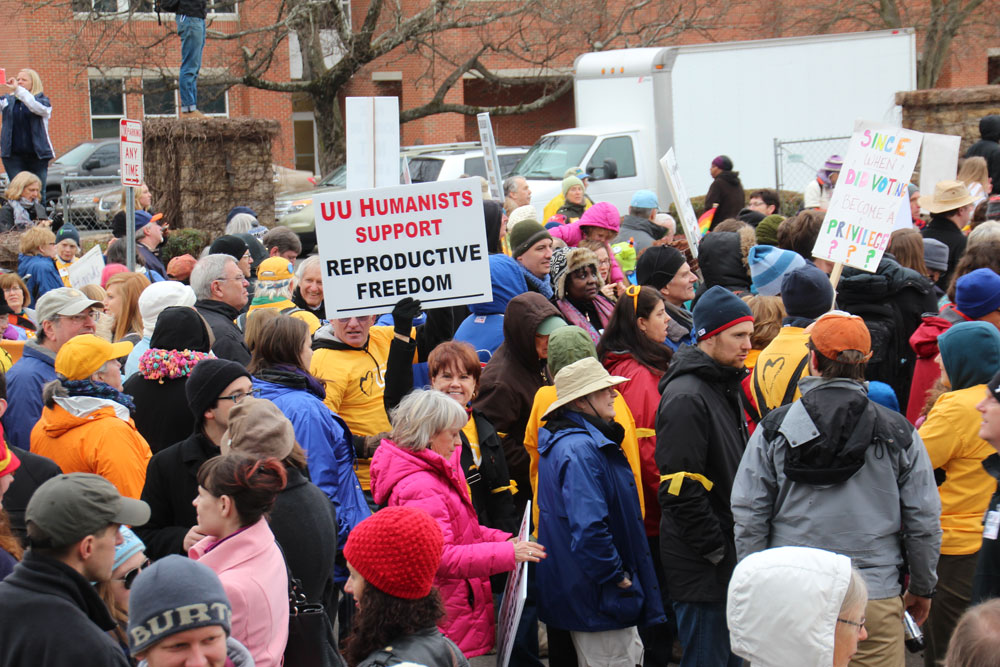
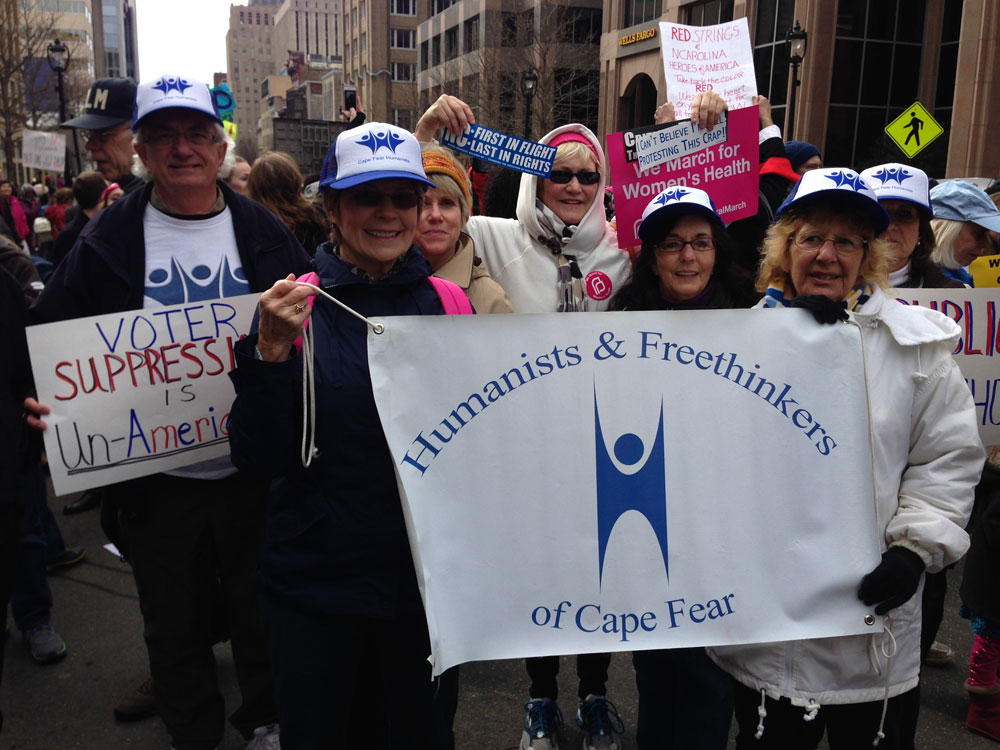
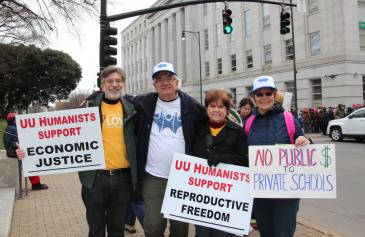
John Hooper and Pat Mohr, president and vice president of the UU Humanist Association, attended the Moral March on Raleigh event on February 8, 2014. In the picture on the right, they are standing with Mike and Susanne Werner, fellow UU Humanists and secular activists. The march brought together approximately 80,000 people from around the country, including UUA president Peter Morales and over 1,500 other UUs, many wearing their bright yellow "Standing On the Side of Love" t-shirts. They came to Raleigh to protest regressive North Carolina GOP policies around health care, education, the criminal justice system and voter suppression that especially disenfranchise the poor and people of color.

The march was led by Rev. William Barber, president of the NC NAACP and a Disciples of Christ minister. Barber has been leading the Moral Monday movements gatherings in the state over the past year. Many secular organizers, including Susanne Werner, co-chair of the Secular Coalition of NC, pictured above on the right, were put off by the very religious language of Barber and the other speakers.  However, the movement's organizers emphasized that Barber's "policy messages, his organization and his objectives are thoroughly secular and open to all, whatever their beliefs or lack thereof when it comes to religion. No modern political movement is as diverse and open as this one." So, Werner made an effort to communicate with Barber about the impact his style of speech was having on inclusivity. According to Werner:

"... [we] attended his press conference in Wilmington the week before the march; it was one of many he was conducting around the state.  We were determined to talk with him... and were gratified that he fully engaged with us in a discussion of the secular support within his movement.  We told him that seculars support his issues (he has the endorsement of Planned Parenthood, LGBT groups, ACLU and he speaks against tuition vouchers going to private schools) and attend his rallies, but there would be more seculars in attendance if the religious language and exclusive Christian references were toned down... He agreed to include seculars in his talks..."

Rev. Barber was true to his word and this is how he described the people who came out for the march:

“We are black. We are white. We are Latino. We are Native American. We are Democrat. We are Republican. We are independent. We are people of faith. We are people not of faith, but who, though they are secular, they still believe in a moral universe. We are people. We are natives and immigrants. We are business leaders and workers and unemployed. We are doctors and the uninsured. We are gay. We are straight. We are students. We are parents. We are retirees. We are North Carolina. We are America. And we are here, and we ain’t going nowhere!”

Many secular progressives are beginning to recognize that we must work in solidarity with the religious in order to achieve our common goals. It is gratifying to see religious leaders recognizing the same thing. Werner stated:

"My view is that if Rev. Barber’s group and we agreed on everything we would be one and the same organization and that we need to build coalitions wherever we can find enough common cause.  My Wilmington group, Humanists & Freethinkers of Cape Fear, was very enthusiastic about supporting the march and we had 12 of us in attendance; 8 of us were able to find each other in the thousands of marchers (even with cell phones it was hard) and wore logo hats and marched behind our banner.

...I am cautiously optimistic that Rev. Barber’s movement will have an effect on our dire political situation here in North Carolina.  The election this year will tell whether we are changing opinions here."

Read more about The Moral March on Raleigh »

Categories: 

The UU Congregation: Habitat for Humanism

This article was originally published in the Humanist Network News. HNN is a weekly news e-zine of the American Humanist Association with a circulation of around 44,000. 


When the topic of Humanist community comes up someone is bound to mention Unitarian Universalism. That is because UUs have what Humanists who want community are looking for. Unitarian Universalism also comes up because a significant number of UUs are Humanists and because organized Humanism was in large part an outgrowth of Unitarianism in its early days. Humanism and Unitarian Universalism go together, and I assert that theover 1,000 UU congregations are natural and practical homes for local Humanist communities.

The national secular movement is growing, and the growth is driven mostly by books, blogs and conventions. We are led by our authors, bloggers and speakers while the rest of us are mostly readers, commenters and attendees. There's nothing wrong with any of that, but we're missing the opportunity to form real, as opposed to virtual, relationships with one other. Our face time is mostly at conventions, which are wonderful, but who can afford to attend more than one or two a year?

We have some local groups that provide opportunities to get together regularly but most local group meetings consist of lectures, book groups or discussion groups. In general (though with exceptions), they don't offer much for families, socializing, volunteerism or social/political engagement and they tend to be few and far between. Scientific studies show the many benefits of social connectednessand most people realize that the staying power of religion has a lot to do with the draw of community. (Many speculate that there are a large number of non-believers in religious congregations who are there purely for the community.) I don't just want a Humanist local group, I want a Humanistcongregation that is fully engaged with my local community and concerned about making the world a better place. I want a place where I can find friendship, a village to help raise my kids, support during life's challenges and all the other benefits that religious folks get (with often a dozen nearby choices) but without having to leave my brain at the door or pretend that I am something I am not.

Read more at the AHA's Humanist Network News page Read more about The UU Congregation: Habitat for Humanism »

Categories: 

Secular Leadership Summit 2014

UUHA president John Hooper recently participated in the Secular Leadership Summit, on January 25, 2014. The event was held in Columbus, OH and was sponsored by the Secular Student Alliance. This meeting, formerly known as the Heads Meeting, brings together the leaders from all of the major non-theistic organizations to discuss strategy and to coordinate activities.

John described the event as, "a very positive meeting" and the people as, "a really cool bunch of folks".  Read more about Secular Leadership Summit 2014 »

Categories: 

The Humanist Community Project & UU Humanists

Have you heard about the Humanist Community Project? They are, "a Cambridge-based initiative to help create, establish, and connect a stronger nationwide network of Humanist communities focused on individual, group, and societal betterment, for the benefit of the secular and freethought movement." In other words, they are group that seeks to promote "Godless Congregations". Greg Epstein, the group's leader, described the project at the HUUmanists 2013 UUA General Assembly program, and explained that "Godless Congregations" is also the title of an upcoming book that he and co-author James Croft are working on. 

It has been the Humanist Community Project's intention to "work with and learn from emerging and established forms of positive community for the nonreligious", including the UUA, from the begining. The UU Humanist Association, fulfilling it's mission "to provide an active interface between Unitarian Universalists and the secular community", has been seeking to assist the group with funding and with facilitating dialog and connections between the HCP and UUA. 

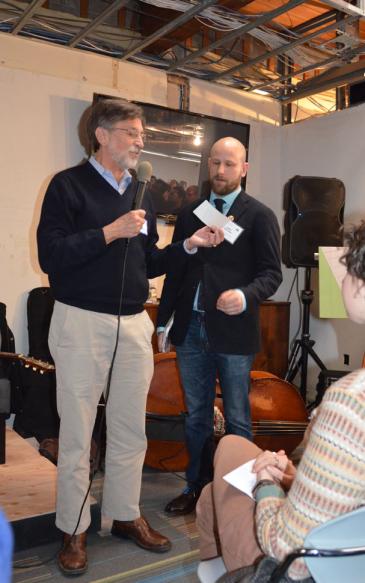
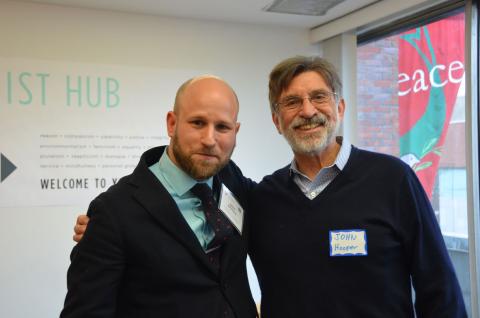
President John Hooper and director Maria Greene represented the UU Humanists at The Humanist Hub grand opening celebration in Harvard Square, Cambridge, MA on December 8, 2013. At the event, John was pleased to present Greg with the first of several checks from the UU Humanists. He had this to say:

I’m very excited about the potential for cooperation between Unitarian Universalists and the Humanist Community Project.  Developing a close working relationship with Greg Epstein’s initiative is a natural for the UU Humanist Association.  The UUHA Board voted unanimously to invest $5000 in this synergistic, cooperative effort.  But ours isn’t the only UU investment in HCP.  The UU Funding panel has also awarded a $5000 grant to the program (initiated by the UUHA), the UUA is putting in $3000, and individual UUs connected with the UUHA have contributed another $12000.  We are looking forward to catalyzing cooperation between the HCP, the UUA and many UU congregations across the country.  As Maria Greene, our development and communications director, has described in a recent AHA Humanist Network News article, Unitarian Universalist Congregations are natural “Habitats for Humanism.”  

Read more about The Humanist Community Project & UU Humanists »

Categories: 

On Becoming Humanist - My Personal Journey from Catholic Educated to Humanist, by Bob Koches

Editor's note: this is another essay in the "Why I Am a UU Humanist" series. What is your story? Contact us and let us share it.

My name is Bob Koches, I am a humanist and this is my journey.  I think of humanism as a kinder, gentler form of atheism. 

Humanist Manifesto III , a successor to the Humanist Manifesto of 1933, defines humanism as a progressive philosophy of life that, without supernaturalism, affirms our ability and responsibility to lead ethical lives of personal fulfillment that aspire to the greater good of humanity.   “The lifestance of  humanism - guided by reason, inspired by compassion, and informed by experience encourages us to live life willfully and fully.  It evolved through the ages and continues to develop through the efforts of thoughtful people who recognize that values and ideals, however carefully wrought, are subject to change as our knowledge and understanding advances.” 

When asking the question of my Lake Chapala Unitarian Universalist Fellowship here in Ajijic, Mexico, 90% said they considered themselves atheist, agnostic or humanist.

My journey is really based on the fourth UU principle, which is a free and  responsible search for truth and meaning.

As you may know, I was educated and raised Catholic, and went to Catholic school from first grade through university.  Kathy, my wife, asked me one time, out of curiosity, why I was no longer a Catholic.  I answered, “Because I went to Notre Dame, and they taught me to think.”

We all ask the basic questions, “Why am I here?  Where did I come from? How did it all start?”  Or in the words of Doug Adams in “The Hitchhiker's Guide to the Galaxy” the question is “What is the meaning of the universe and everything?”  Of course the answer, as you may know, is “42” but that doesn’t really suffice here.

When I was in high school at Pius X, I took a class in my senior year called “in apologia” or “in defense of the faith” taught by a young priest called Father Parnassus.  He stated that Catholicism  could be and should be defended by logic.   Of course that only works if you accept the basic assumption that there is a god.  If you don’t, it all “goes to hell in a hand-basket.”

The next year it was off to Notre Dame, where I learned about the Greek philosophers.  Socrates taught me to doubt and question everything.   Of course Socrates, in his time, questioned the validity and existence of all those Greek gods.  He developed what is now called “the Socratic method,” which is basically asking questions, questions, questions, to get at some semblance of the truth.  He was a humble man, and felt he hardly knew anything.  From the Greeks we also get the aphorism, “Know thyself.”

Plato, through his allegory of “The Cave,” warped my sense of reality, saying that what we perceive is not real, but merely shadows on a cave wall.  Another parable of this is the blind men and the elephant.  Not Plato, but still the same result.  We only get glimpses and pieces of what reality may be.

Aristotle invented formal logic and is considered the father of what we would now call “The Scientific Method.”  One of his other claims to fame is the concept of “first cause” or “the unmoved mover.”  This is another term for god, which states that god had no beginning.  Thomas Aquinas used this as one of his proofs of the existence of god.

One of the best definitions of god I ever heard was from Paul Tillich, a German theologian, whom the Christian right considers at best, a panthiest and at worst, an atheist.  He said, and I paraphrase, “That which you cannot explain:  the wonder, the magic and the mystery in the world, people call ‘god’,  until some of these wonders, magic and mysteries can be explained through science.”   In other words, the mystery and wonder in the universe is just something we have not explained yet.

In looking at the history of man, it became clear to me that god was created in man’s image, not vice versa.  The study of history showed me that early civilizations were religiously based.  These theocracies were then governed and controlled by the priests.   If you look at what is happening in America today, you can see the same pressures being applied.

It is interesting to me to note that there are many atheistic religions in both the ancient and modern world, including forms of Buddhism, Hinduism, Judaism, Jainism and Confucianism.  It is also interesting to me to note that almost all of the religions of the world have, in some way, the ethic of the golden rule.

Therefore, I concluded that “humanism” or acting in a humane way towards other people, does not need to be tied to religion.

So let’s talk about some objections to atheism.  Kathy’s dad used to say, “If you’re right, and I’m wrong, I have lost nothing; but, if I’m right, and you’re wrong, you are in big trouble.”  This is known in philosophical circles as “Pascal’s Wager.” 

There are really two problems with this:  first of all, which religion?  There are many.  It seems to me a little egotistical to limit it to just one.  The second problem is really, “it is playing the odds” and I would rather the odds of living a good and happy life now as opposed to in heaven.

Besides, the new Pope, Francis, has said that if an atheist leads a good life he can go to heaven.  So, all bets are covered! 

I also have a real problem with a literal interpretation of the bible by creationists that says man, dinosaurs and dragons co-existed together.  The concept is so ridiculous I am not going to bother to talk about it.

I am, in some ways, envious of true believers, people of faith, who are so certain, through whatever life experiences they have had, that they are right.  Unfortunately, I have never had, like Paul on the road to Damascus, that bolt of lightening come down and show me the ultimate truth.  With a person who has this type of faith, there is no arguing.  They cannot accept my facts, and I cannot accept their blind faith.  So we are at an impasse.  If they live a life consistent with their faith, rather than a life of hypocrisy, then I can accept them.

So, where does that leave me on this journey?  There are many nooks and crannies of thought that I haven’t covered, but when it comes to living a humane life, a life consistent with caring for our fellow man, I still prefer to see the wonder and awe of the universe as it is explored by science.   

For the atheist and humanist there is wonder and mystery about this process of existence, but not the kind which leads to fear or rejection. Rather, the atheist’s and humanist’s wonder and mystery is enthusiastic curiosity about all those unknowns, which are just waiting to be revealed. 

As the great Albert Einstein said:  “The important thing is not to stop questioning.  Curiosity has its own reason for existing. One cannot help but be in awe when one contemplates the mysteries of eternity, of life, of the marvelous structure of reality.  It is enough if one tries merely to comprehend a little of this mystery every day.  Never lose a holy curiosity.”      Namaste. Read more about On Becoming Humanist - My Personal Journey from Catholic Educated to Humanist, by Bob Koches »

Two Views on the History and Promise of the Unitarian Universalist Association

As part of Michael Werner's New England book tour, he made a stop at The Unitarian Church of Westport, CT for an event with Denny Davidoff, moderated by HUUmanists president John Hooper. Here is the video from that event with great thanks to Wilson Converse of eyedit.tv.

Two Views on the history and Promise of the Unitarian Universalist Association. A discussion

Categories: 

Ethical Dilemmas and Humanist Ethics

Michael Werner gave an excellent talk at the Concord Area Humanists meeting on October 23, 2013 about Humanist Ethics. Mike and his wife Susanne were in the area as part of Mike's book tour to promote his new book "Regaining Balance: The Evolution of the UUA". Here is the video of Mike's talk. (If the video does not appear below, try this link.)

And here are the slides:

Read more about Ethical Dilemmas and Humanist Ethics »

Categories: 

"You Are Theist, I Am Humanist"

Here's to the goal of not taking ourselves too seriously!

Sung by J.T. Bakes & Max Gibson

Lyrics

You are theist I am humanist
I think that you're naive
You have no proof to offer as truth,
You simply say "I believe"

New age bubbles get you in trouble
Lost in a feel-good fluff
True understanding is quite demanding
Praying is not enough.

Totally unprepared are you
To make a case that's plain
Maybe the incense, chants, and drums
Have ruined your poor brain.

You need someone older and wiser
Telling you what to do,
You are theist, I am humanist
I--will think--for you!

I am theist, you are humanist
You're locked inside your head.
You're existential, self-referential
Claiming that God is dead,

Occam's razor, Pascal's wager
Soul-less tautology
Wisdom, traditions, not erudition
Make much more sense to me.

Totally unprepared are you
To let go of your mind.
How 'bout a leap of faith, my friend
You might like what you find.

When you find that you're out of answers
You won't know what to do
I am theist, you are humanist,
I -- will pray -- for you.

We cannot agree on anything
Each has a point of view,
I am theist --- I am humanist
That's why we're UU.

by Meg and Scott Bassinson of Albany, New York. Read more about "You Are Theist, I Am Humanist" »

Categories: 

Mike Werner's New England Book Tour

Michael Werner is going to be touring the New England area in October, speaking about his new book "Regaining Balance: The Evolution of the UUA". If you are in the area you can see Mike speak at the following events:

Categories: 

Pages