Congratulations, Stefan Jonasson

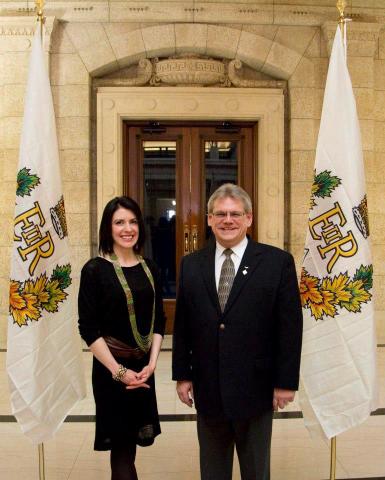
The HUUmanists Association is happy to congratulate one of our board members, Stefan Jonasson, for being awarded the Queen Elizabeth II Diamond Jubilee Medal by his home country of Canada.


Deanne Crothers, MLA for St. James, with Stefan Jonasson after the Queen Elizabeth II Diamond Jubilee Medal presentation ceremony

We enjoyed Stefan's Facebook announcement when he was told he was to receive the award:

I am humbled and honoured to be able to announce that I will be presented with the Queen Elizabeth II Diamond Jubilee Medal at a special ceremony in the Manitoba Legislative Building a week from today. [April 11, 2013] According to The Chancellery of Honours, "The Queen Elizabeth II Diamond Jubilee Medal is a tangible way for Canada to honour Her Majesty for her service to this country. At the same time, it serves to honour significant contributions and achievements by Canadians." Recipients must have made "a significant contribution to a particular province, territory, region or community within Canada, or an achievement abroad that brings credit to Canada." And then there's me.

Well done, Stefan, and we appreciate all the work you do for HUUmanists and for the UUA in your role as Director of Growth Strategies and Large Congregation Development.

Categories: 

Ribbons Not Walls

Ribbons Not Walls is the title of two related Social Justice projects that will be featured at the HUUmanists General Assembly booth in Louisville this coming June.  You are invited to participate in either or both. 

A "Banned Books by Hispanic Authors" library will be created with a community group in Louisville - this is a continuation of our Banned Book SmUUggling project from the Phoenix GA.  We are collecting multiple copies of 70 plus books that were removed from Tucson classrooms by the State of Arizona (see previous blog posts from Nov 18 and August 19 for full details).   Please consider purchasing one of the books, and sending it to us well in advance of June, so that we can ship all the titles together.  Of course, if you are planning on coming to Louisville, just bring the book - but let us know which title.   The complete list of banned books is available on Ribbonsnotwalls.org, along with the address to which to send your selection.   

The Ribbon project is a large fabric arts work, consisting of two dozen or more panels created by UU and humanist artists around the country.  It will be on display at our booth in the Exhibit Hall at GA (along with other subsequent venues) and will be paraded throughout the week at major GA events.  Panels depict ongoing immigrant rights work, along with themes from several of the Banned Books.  (See the Gallery below for examples.) Applications are still being accepted from individuals and groups willing to contribute a panel, and have their work seen by hundreds of delegates.   Full details are at Ribbonsnotwalls.org.

If your question isn't answered by the website, feel free to contact Roger Brewin at 773 881 4028 or 773 551 8540, or Rabrewin@aol.com.

Categories: 

Meadville Lombard Announces Humanist Archive

Meadville Lombard Theological School in cooperation with HUUmanists Association has announced the establishment of a Humanist Archive to be housed in the Wiggin  Library at the school.  The details of the announcement may be found on the Meadville Lombard website

The originating scholars and theologians of American Humanism, primarily early and mid 20th century Unitarians, generated an astonishing body of work.  These seminal books, sermons, speeches and other writings are important foundational documents of Unitarian Universalism.  Not only must they not be allowed to drift into obscurity, they need to be reintroduced to the public discourse.   They have much to say to present generations of theologians, scholars, and other seekers, who have grown skeptical of traditional religious practices and beliefs.  

Half of the signers of the original Humanist Manifesto were Unitarian ministers who promulgated "a religion without gods." We Humanists, secular or religious, must address the contemporary longing for understanding, compassion and love within a beloved community - felt even by those who are not affiliated with any religious tradition (the so-called "Nones").  

Our Humanist forebears sought to move our faith beyond mere theism or atheism to a worldview that celebrates not only the importance of rational inquiry but also the shared wonder of lived experience.  They were eloquent in their descriptions of how we might try to do it.  We UUs need their witness now more than ever.  

Categories: 

Latest Journal of Religious Humanism

Attendees at the UU Minister's Association biennial institute in January each received a copy of the latest issue - titled "Humanism and Ministry." Many UU clergy, especially those whose training and experience come in part from other religious traditions, have little knowlege of humanism as practiced in the congregations of the UUA, and little in the way of a track record ministering to humanists.  With roughly half of the 160,000 adult UUs identifying with or sympathizing with humanism, it's important to offer them exposure to the wide range of values, inclinations and needs of such a significant portion of their congregants.

Much of what humanists desire is what all UUs desire - the blessings of community, personal support and an opportunity to act together with others on a variety of mutual goals.  The humanist authors in this issue focus largely on what is unique about our particular claims on Unitarian Universalism, its congregations and its ministers. The differences with non-humanist claims are often subtle, but are important to enabling humanists to continue the myriad contributions we have made to liberal religious life over the past eight decades.

Two veteran humanist ministers, Sarah Oelberg and Mary Louise DeWolf, gently take apart the prevailing concept of UU churches as communities dedicated primarily to growing their members towards "spiritual maturity."  Their colleague at our Detroit church, Roger Mohr, offers an alternative vision of the Humanists (liberal) congregation-to-come as both a center of bold leadership for the wider world, and a community to equip and support those willing to take on such leadership.

John Hooper and Michael Werner point to the demographic phenomenon of the "nones" as an opportunity to rework the here-and-now of UUism, while Jill Rafferty Weinisch describes a parallel-to-UU ministry in the secular world. Michael Tino and Glenn Keldsen offer detailed examples of humanist worship and science based congregational programming.  

Categories: 

President's Corner

The HUUmanists Association experienced a very productive and rewarding Justice GA last June, featuring a keynote address by Bill Murry on “Economic Justice: A Moral Imperative for UU Humanists” and a hugely successful “Book SmUUggling” project in the exhibition hall. See Roger Brewin’s GA Booth summary later in this Newsletter.

Summary of our annual membership meeting, held on June, 22, 2012

Our treasurer, Greg Seaman, reviewed our successful program to bring our revenue and expenditures into balance through cost reductions and increased paid membership. Our budget for the 2012-2013 fiscal year projects a surplus of $2,000.

The nominated slate of officers and new at-large board members was introduced, discussed and approved, with four individuals being elected for the first time. Subsequent to GA, Gayle C. Walter resigned as an at-large Director and Lowell Steinbrenner was appointed by the Board to complete her term. On behalf of the Board and the entire membership of HUUmanists, I extend our sincere thanks to Gayle Walter, Rev. Jane Esbensen, and Walter Wells for their dedicated service as officers and directors of our Association, and for all they do or Humanism and Unitarian Universalism. The current set of Officers and Board is on the website.

The annual meeting was addressed by the dynamic leaders of three organizations, with whom the HUUmanists Association has forged working relationships in the support of reason and compassion in our society. Edwina Rogers, the Executive Director of the Secular Coalition for America, described the accelerated ramp-up of efforts, on both the national and state levels, to increase the visibility of non-theist values and to defend the separation of church and state. Serah Blaine, the Executive Director of the Secular Coalition for Arizona, described the particularly difficult but critical work that SCA is doing in a state whose elected leaders have shown a particularly egregious tendency to mix religion and politics. Tony Diaz, the founder of Librotraficante, related the passionate and effective actions of the Librotraficante movement in countering the effects of Arizona House Bill 2281, which resulted in the removal of books on ethnic studies from Arizona public schools. He thanked the HUUmanists Association for our Book SmUUggling project. His program continues to fight for the repeal of the Arizona law, with a new underground library set up in Phoenix with the books donated at GA, and with more activities, such as teach-ins in every state during Spanish Heritage month.

The State of HUUmanists Association and a Look Ahead

I’m excited about what your HUUmanist Association has accomplished and optimistic about how we are positioned for the important work ahead. Our officers and directors make up a team of extraordinary and accomplished Unitarian Universalist Humanists. I feel both honored and humbled to be working with them. Together, we are developing a comprehensive and multifaceted program to strengthen and extend Humanist influence both within Unitarian Universalism and in the world at large:

  • Publishing: We are collaborating with the American Humanist Association in the publication of the electronic version of Bill Murry’s very successful book: Becoming More Fully Human and planning the publication of additional titles
  • Conscientious Stewardship of UU Humanist History: We are working with Meadville Lombard Theological School to establish an Archive of Humanist Documents and Materials
  • “Embodied Humanism:” Our Book SmUUggling project at the 2012 GA is only the beginning of a concerted effort to make sure we actively live out our Humanist values of reason and compassion, and not just talk about them
  • Education: We continue to actively work with The Humanist Institute and the Institute for Humanist Studies in providing opportunities for emerging secular and religious humanist leaders to build their skills and deepen their knowledge base.
  • Becoming a Primary Interface (Bridge) between the Secular/Non-believing Communities and Unitarian Universalism: This initiative could provide an unprecedented opportunity for us to truly fulfill our dual mission of being the voice of reason and compassion (without supernatural assumptions) within Unitarian Universalism and an advocate for Unitarian Universalism in the freethinking community at large.

These are the steps we are taking to make this happen:

  1. Help to establish and/or strengthen local Humanist and freethinker groups in close cooperation with secular Humanist organizations.
  2. Mobilize UU individuals, institutions, and congregations to actively support the activities of our partner organizations, especially those of the member organizations of the Secular Coalition for America.
  3. Be recognized by the UUA and individual Unitarian Universalists as the entity assuming responsibility for building bridges with the secular/non-believing community in UUA President Peter Morales’s Congregations and Beyond initiative. We are in discussions with UUA leadership about this.
  4. Focus our 2013 GA activities on our role as a bridge between Unitarian Universalism and the secular/non-believing communities. American Humanism coalesced and began to flourish almost a century ago when it captured the imagination of freethinking young people at the University of Chicago and Meadville Lombard Theological School.

I believe that, like our forebears, we Unitarian Universalist Humanists have a special role to play with the freethinking people – especially the young people – of today. We must accept them where they are in their life journeys. Our congregations need to be more openly welcoming to atheists, agnostics – indeed to nonbelievers of all stripes. Young nonbelievers of today deserve the same opportunity that was given to all of us – the opportunity to find a home in Unitarian Universalism, where their life stance will be not only welcomed, but also celebrated and shared. “If not us, who? If not now,when?”

Categories: 

Pages

Subscribe to Front page feed