
1. Get your leadership’s approval to seek this designation
2. Meet the program requirements
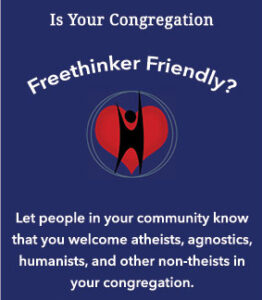
- Publish a Welcoming Statement: Include language that clearly includes atheists, agnostics, humanists, and other non-theists.
- Start with a warm conversation with your minister about your desire to help your congregation continue the model of the Welcoming Congregation, with a special goal of reaching out to welcome the growing number of “nones” in our culture who currently say they have no faith community. If possible, engage the minister’s help in the entire process.
- Create an inclusive welcoming statement which includes words specifying that we are welcoming to people of all religious beliefs, or none. The wording is left up to your team. See “Crafting a Freethinker Friendly Welcome Statement.”
- Present your suggested welcoming statement to your congregation’s board or appropriate leadership group, for their approval and/or suggested revisions.
- Publish the statement on your website, include information on your welcome table, frame it in the foyer, or share it however your congregation chooses.
- Examine your rituals and language and update them as needed. Discuss, as a congregation, ways to be more inclusive and welcoming.
- Encourage your minister to dedicate a Sunday to discussing what Freethinker Friendly means, and how it can help welcome people with no religious affiliation into the community.
- As with the Welcoming Congregation process, your congregation may want to create a seminar to discuss the history of humanism in UU, how becoming more openly Freethinker Friendly can help your congregation grow, etc.
- As leaders, reflect on your own beliefs. Do you have any prejudices or stereotypes associated with non-theism, or of theism? Even if you consider yourself a humanist, do you vilify “fundamentalist atheists?”
- Look at your congregation’s practices, with the involvement of board, staff and congregational members. If you claim to be a community of people of all religious views and none, do your “worship” services tell a different story? Are you sensitive to non-inclusive language which might distance non-theistic people or make them feel disrespected? Do non-theistic visitors need to “translate in their head” the words they hear or read even before they become aware of our tradition of using these words in a more liberal context?
- Provide time and space to celebrate the Humanist worldview, such as regular humanist services or meetings of a humanist local group.
- Provide opportunities for non-theists to connect in small groups for study and/or social interaction, like forming an ongoing Freethinker Forum to highlight humanistic outlooks.
- Publicize this group in your newsletter. The UUA encourages all congregations to provide opportunities for “spiritual exploration” such as “Build Your Own Theology” or groups that focus on different worldviews.
- Consider having your freethinker group become a chapter of UUHA.
- Contact us for links to other UU congregations who have humanist/freethinker groups, and reach out to share ideas.
- Connect with Local Humanist Groups: Reach out to the wider non-theistic community and let them know you exist and that you want to support them.
- If you have a freethinker group, connect with other local groups who are non-theistic, like atheist, agnostic, or skeptic groups and philosophy societies, as well as Humanist, Reform Jewish, and progressive Christian communities. Use them as resources for shared interests and collaborate when you can.
- Invite members of the wider community to your freethinker events, and visit other groups. If you have a Freethinkers Forum, publicize it not only in your congregational newsletter, but also in community event calendars or newspapers.
- Consider affiliating with other national groups like American Humanist Association, Freedom from Religion Foundation, Americans for Separation of Church and State, etc. We are stronger together. Urge your members to support these national efforts. In return, they often provide stimulating speakers for your local group.
3. Apply by filling out our online form.
Fill out our interest form so we can contact you when the application is ready to share.